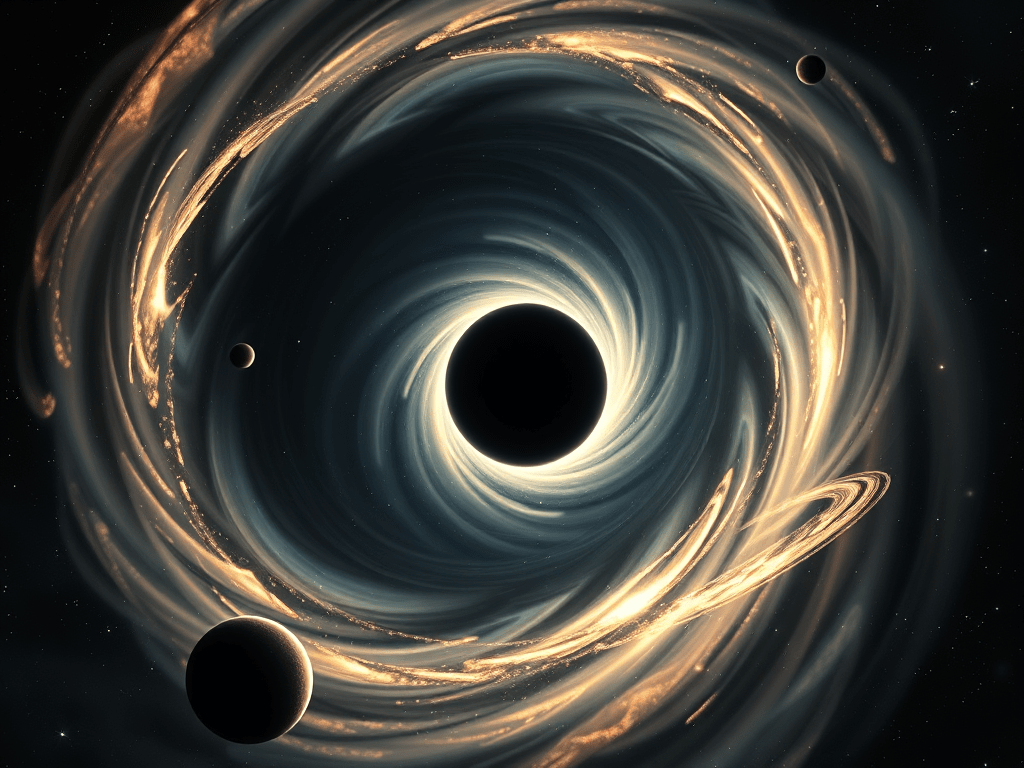
Black holes are no longer a novel concept to those interested in astrophysics. However, fundamental questions regarding their origins, mechanics, and related phenomena persist. This article aims to elucidate these concepts—Black Holes, White Holes, and Wormholes—in the most concise and scientifically rigorous manner.
I. Black Holes
The theoretical framework for black holes emerged shortly after the publication of Albert Einstein’s General Theory of Relativity in 1916. Karl Schwarzschild proposed the first exact solution to the Einstein field equations, predicting a region of space resulting from extreme gravitational collapse. This remained purely theoretical until the discovery of neutron stars, which provided the first observational evidence of gravitational collapse following stellar death.
Formation and Fundamental Concepts
Black holes typically form via the following mechanism:
When a massive star exhausts its nuclear fuel—specifically, when all available hydrogen has undergone thermonuclear fusion to form helium—the outward thermal pressure generated by fusion ceases to balance the inward force of self-gravity. Consequently, the star undergoes gravitational collapse.
During this contraction, helium nuclei are compressed and fuse into heavier elements (Carbon, Oxygen, etc.), releasing energy that causes the stellar envelope to expand significantly (the Red Giant phase), while the core continues to contract rapidly.
- For solar-mass stars: The outer envelope is ejected after reaching a certain expansion limit, forming a planetary nebula. The core collapses into a White Dwarf.
- For massive stars: The core undergoes a final, catastrophic collapse due to the fusion of heavy elements, resulting in a Supernova explosion. The ejected gas and dust form a Supernova Remnant.
The post-explosion core fate depends on its mass:
- White Dwarf: For stars like the Sun, the core becomes a dense, cooling object supported by electron degeneracy pressure.
- Neutron Star: For cores exceeding the Chandrasekhar limit (), electrons are compressed into protons to form neutrons. The result is a neutron star with immense density and rotational velocity.
- Black Hole: For cores exceeding the Tolman–Oppenheimer–Volkoff limit (), neutron degeneracy pressure cannot halt the collapse. Matter is compressed beyond a critical point, leading to total collapse.
In General Relativity, the gravitational field is the curvature of spacetime caused by mass. When this mass collapses (conserving its magnitude), it curves the surrounding spacetime into a closed region. This object becomes a Black Hole. The boundary of this closed region is the Event Horizon. All matter from the collapsed core concentrates at a single point called the Singularity, where density is infinite and known physical laws break down (similar to the primordial state of the Big Bang).
Supermassive Black Holes (SMBHs)
These are the most massive distinct objects in the universe, residing at the centers of most large galaxies (Active Galactic Nuclei). SMBHs possess masses ranging from hundreds of thousands to billions of solar masses (). Unlike stellar-mass black holes formed from stellar death, the growth mechanism of SMBHs remains a subject of research.
Two primary scenarios exist:
- Accretion and Mergers: They begin as seed black holes (tens to 100 ) and grow via merging with other black holes and accreting gas. However, this requires unrealistically high accretion rates to explain early universe observations.
- Direct Collapse: A more favored hypothesis suggests SMBHs formed from the direct collapse of massive primordial gas clouds, starting with initial masses of at least .
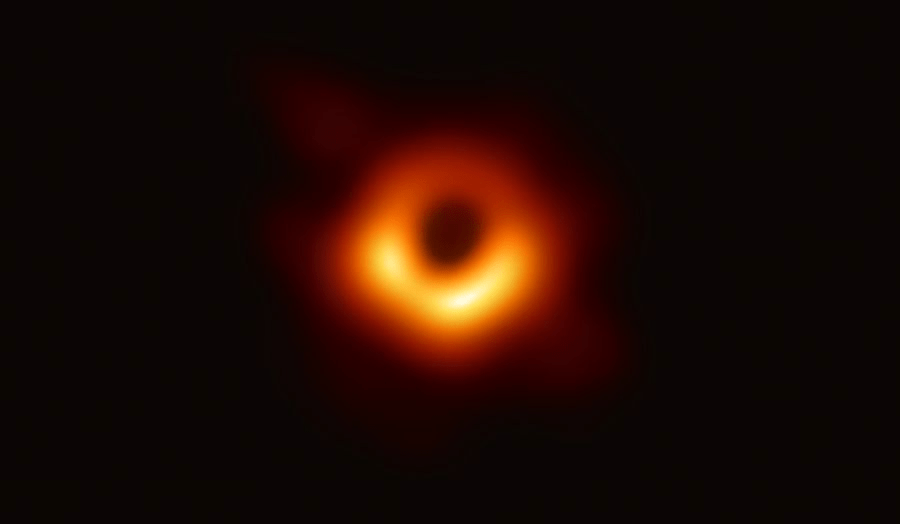
At the center of the Milky Way lies Sagittarius A*, a radio source associated with an SMBH of approximately .
The Mechanism of Black Holes
Because spacetime curvature within the event horizon is extreme, all paths lead inward. Nothing, not even light (photons), can escape once it crosses this boundary. This is analogous to a one-way curved road where the geometry compels you to follow the curve, regardless of external intent.
Crucially, the bending of light near a black hole is due to the curvature of spacetime, not because photons possess kinetic mass (a common misconception).
Regarding matter: Within the event horizon, tidal forces approach infinity, causing spaghettification—the vertical stretching and horizontal compression of any object, tearing it apart at the atomic level. Consequently, survival or data transmission from inside a black hole is physically impossible.
Can we observe black holes?
Directly, no. Black holes neither emit nor reflect light. However, their existence is inferred through gravitational interactions, such as:
- Accretion of matter from companion stars (emitting X-rays).
- Gravitational Lensing (bending of background light).
- Gravitational Waves from mergers.
The Black Hole Information Paradox
In 1997, Stephen Hawking bet John Preskill that black holes evaporate via Hawking Radiation, destroying all consumed information. Preskill argued that information is conserved. In 2004, Hawking conceded, presenting a theoretical framework where information might be preserved, though the mechanism remains debated.
Existential Verification
Do black holes truly exist? While we cannot “see” them directly, the observational signatures (accretion disks, orbital dynamics of S-stars like S2, gravitational waves) fit the black hole model exclusively. No other celestial object explains these phenomena. Thus, scientifically, they exist.
II. White Holes
Unlike black holes, White Holes are purely theoretical mathematical solutions to Einstein’s field equations and have never been observed.
Conceptually, a white hole is the time-reversal of a black hole. It possesses an event horizon and a singularity. However, while a black hole allows matter to enter but not exit, a white hole expels matter and radiation but allows nothing to enter.
Is it Anti-Gravity?
No. A white hole possesses positive mass and attractive gravity. It attracts matter, but any object reaching its event horizon would be scattered and reflected by the immense outward pressure of the spacetime geometry.
Thermodynamic Violation
The existence of white holes violates the Second Law of Thermodynamics (which states entropy must increase). A white hole would decrease entropy. Furthermore, if they existed, they would be highly unstable and collapse almost instantly.
A theoretical resolution suggests white holes might exist in a different universe or a different region of spacetime, connected to black holes via wormholes.
III. Wormholes
The Maximally Extended Schwarzschild Solution implies that the geometry connecting a black hole and a white hole forms a tunnel known as a Wormhole (or Einstein-Rosen Bridge).
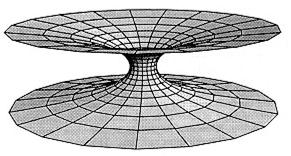
This concept links two separate points in spacetime (or two different universes). While theoretically permitted by General Relativity (which is time-symmetric), wormholes face significant physical barriers:
- Instability: They would collapse instantly without “exotic matter” (negative energy density) to keep the throat open.
- Thermodynamics: Like white holes, they violate entropic laws.
Despite being improbable in the observable universe, wormholes are a staple of theoretical speculation and science fiction, offering hypothetical mechanisms for Faster-Than-Light (FTL) travel (Warp Drive) or Time Travel (Closed Timelike Curves).
Conclusion
While black holes are established astrophysical reality, white holes and wormholes remain mathematical artifacts of the Schwarzschild geometry. Current cosmological models suggest their existence in our observable universe is highly unlikely.
 Khanh's Gallery
Leave a comment