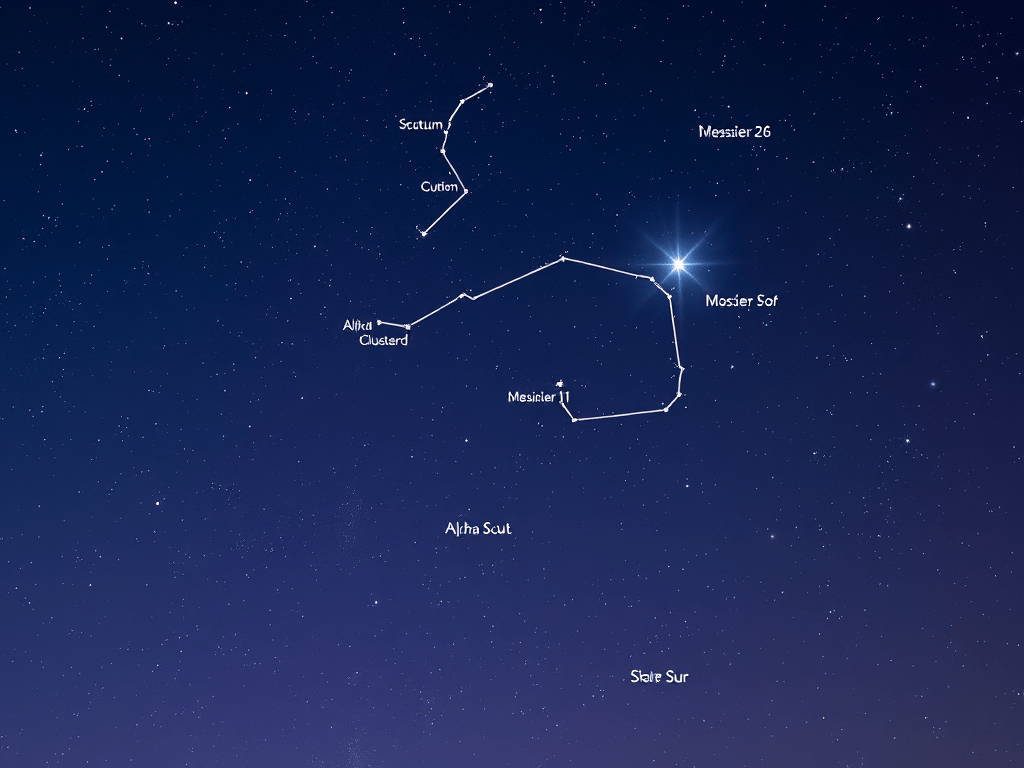
The constellation Scutum is located in the southern sky. Its name means “the shield.” It is the fifth-smallest constellation in the sky.
The constellation was originally introduced by the Polish astronomer Johannes Hevelius in the 17th century. Hevelius named it Scutum Sobiescianum (Sobieski’s Shield) to honor the Polish King Jan III Sobieski, who won the Battle of Vienna in 1683. Hevelius created this constellation a year later to commemorate this event, and the name was eventually simplified to Scutum.
The most famous deep-sky objects in Scutum are Messier 11 (the Wild Duck Cluster) and the open cluster Messier 26. This constellation is also home to the famous variable star Delta Scuti and the red supergiants Stephenson 2-18 and UY Scuti, both of which hold the title of the largest known stars.
LOCATION OF SCUTUM IN THE SKY
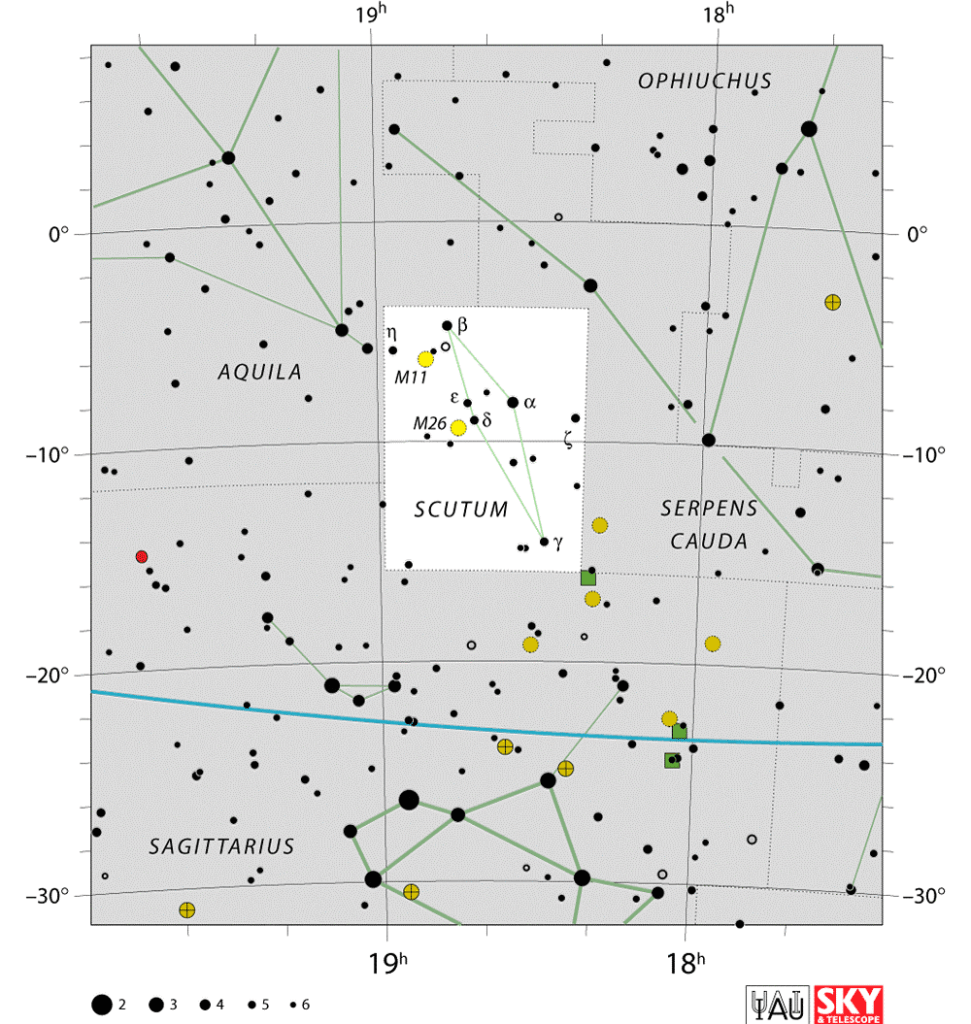
Scutum is the 84th constellation in size, occupying only 109 square degrees. It is located in the fourth quadrant of the southern hemisphere (SQ4) and can be seen at latitudes between +80° and -90°. Neighboring constellations are Aquila, Sagittarius, and Serpens.
Scutum does not possess any stars brighter than magnitude 3.00 or stars located within 10 parsecs (32.6 light-years) of Earth. The brightest star in the constellation is Alpha Scuti, with an apparent magnitude of 3.85. The nearest star is LHS 3398 (spectral type M1V), located 41.54 light-years from Earth. Scutum has only one star with a confirmed exoplanet, COROT-17 (spectral type G2V).
The constellation does not contain any stars with traditional proper names.
Scutum belongs to the Hercules Family of constellations, along with Aquila, Ara, Centaurus, Corona Australis, Corvus, Crater, Crux, Cygnus, Hercules, Hydra, Lupus, Ophiuchus, Sagitta, Scutum, Serpens, Sextans, Triangulum Australe, and Vulpecula.
Scutum contains two Messier objects: Messier 11 (M11, NGC 6705, Wild Duck Cluster) and Messier 26 (M26, NGC 6694). There is a meteor shower associated with the constellation, the June Scutids.
ORIGIN OF THE NAME SCUTUM
The constellation Scutum is not associated with any mythological stories. It is the only constellation associated with a non-classical historical figure, the Polish King Jan III Sobieski.
Polish astronomer Johannes Hevelius, who created this constellation in 1684, named it Sobieski’s Shield to commemorate the King’s victory in the Battle of Vienna in 1683. King Jan III Sobieski also helped Hevelius rebuild his observatory after a fire in 1679.
The constellation Scutum first appeared in the scientific journal Acta Eruditorum in August 1684. Hevelius cited Robur Carolinum (Charles’ Oak), a constellation introduced by the English astronomer Sir Edmond Halley in 1679 to honor King Charles II of England. Halley’s constellation was located between Crux and the ship Argo, representing the oak tree where King Charles II hid from Oliver Cromwell’s troops after the Battle of Worcester, the final battle of the English Civil War in 1651. Later, Robur Carolinum fell out of use. Sobieski’s Shield was eventually shortened to Scutum, the shield.
MAJOR STARS IN SCUTUM
Ionnina – Alpha Scuti
Alpha Scuti is the brightest star in the constellation. It is an orange giant with a spectral classification of K2III. It has an apparent magnitude of 3.85 and is approximately 174 light-years from Earth. The star formerly belonged to the constellation Aquila and was previously designated 1 Aquilae. It is a known variable star, with its brightness varying by about 10 percent. Alpha Scuti is 132 times more luminous than the Sun and has a mass 1.7 times that of the Sun. It is estimated to be at least 2 billion years old.
Beta Scuti
Beta Scuti is the second-brightest star in the constellation Scutum. It has an apparent magnitude of 4.22 and is approximately 690 light-years from the Solar System. It is a yellow bright giant with a spectral classification of G5II, shining about 1,270 times brighter than the Sun. The star was formerly known as 6 Aquilae.
Zeta Scuti
Zeta Scuti is a yellow giant with a spectral classification of G9 IIIb Fe-0.5. It has an apparent magnitude of 4.68 and is approximately 207 light-years from the Sun. It is the third-brightest star in the constellation. Zeta Scuti is an astrometric binary system; a binary star seemingly orbiting an empty space where no companion is visible or detectable. The star has an orbital period of 6.5 years.
Gamma Scuti
Gamma Scuti is a white subgiant belonging to the spectral class A1IV/V. It has an apparent magnitude of 4.67 and lies approximately 291 light-years from Earth. It is the fourth-brightest star in the constellation.
Delta Scuti
Delta Scuti is a famous variable star in the constellation Scutum, serving as the prototype for an entire class of variables, the Delta Scuti variables, sometimes called dwarf Cepheids. These are variable stars that exhibit brightness fluctuations resulting from both radial and non-radial pulsations on their surfaces. Delta Scuti has a spectral classification of F2 IIIp. It is a yellow-white giant with a mass 2.23 times that of the Sun. It has two companions in the same line of sight: one with a visual magnitude of 12.2 at 15.2 arcseconds, and another with a magnitude of 9.2 at 53 arcseconds. Delta Scuti has an apparent magnitude of 4.72 and is 202 light-years from the Solar System. It has an oscillation period of 0.19377 days, and its brightness varies by 0.2 magnitudes. The star actually has multiple pulsation periods; the main period is 4.65 hours and a secondary is 4.48 hours, with additional periods of 2.79, 2.28, 2.89, and 20.11 hours.
Eta Scuti
Eta Scuti is an orange giant object belonging to the spectral class K1III. It has an apparent magnitude of 4.83 and is 207 light-years away. This star has a mass 1.4 times that of the Sun and more than 10 times the Solar radius. Its estimated age is about 2.8 billion years.
Epsilon Scuti
Epsilon Scuti is a multiple star system. It has an apparent magnitude of 4.88 and is approximately 523 light-years from Earth. The system has a spectral classification of G8II, consistent with the spectrum of a yellow bright giant. The main component in the system is a luminous class G giant. The star has at least three companions: two magnitude 14 stars at distances of 13.6 and 15.4 arcseconds, and a magnitude 13 star separated by 38 arcseconds.
R Scuti
R Scuti is a yellow supergiant classified as an RV Tauri variable. RV Tauri variables are pulsating variable stars with distinctive light variations and brightness fluctuations caused by radial pulsations of the star’s surface. R Scuti is the brightest known RV Tauri variable. It has an apparent magnitude ranging from 4.2 to 8.6 and is 1,400 light-years from the Sun. R Scuti was discovered by the English astronomer Edward Pigott in 1795. This star has a radius 87.4 times that of the Sun and is 9,400 times as luminous. At its brightest, it can be seen without binoculars. It lies approximately one degree northwest of Messier 11 (the Wild Duck Cluster).
PSR B1829-10
PSR B1829-10 is a pulsar, a rotating neutron star that emits a beam of electromagnetic radiation. It has an apparent magnitude of 5.28 and is 30,000 light-years from the Solar System. It has a mass 1.4 times that of the Sun.
DEEP SKY OBJECTS IN SCUTUM
The Wild Duck Cluster – Messier 11 (M11, NGC 6705)
The Wild Duck Cluster was discovered by the German astronomer Gottfried Kirch in 1681 and was included in Messier’s catalog in 1764. It is an open cluster with an apparent magnitude of 6.3. It is one of the most compact and rich open clusters known.
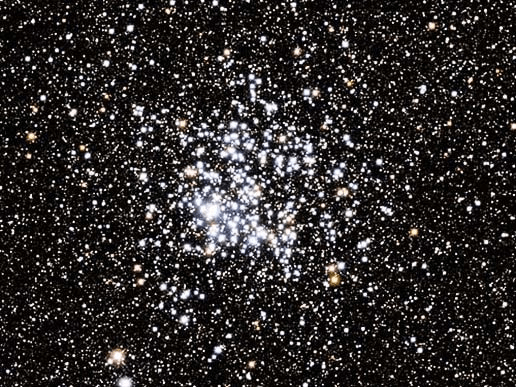
M11 contains about 2,900 stars. The brightest stars in the cluster form a triangle resembling a flock of flying ducks. The cluster is approximately 6,200 light-years from the Sun. It is estimated to be 220 million years old.
Messier 26 (M26, NGC 6694)
Messier 26 is another open cluster in the constellation Scutum. It has an apparent magnitude of 8.0 and is approximately 5,000 light-years from Earth. This star cluster was discovered by Charles Messier in 1764 and subsequently included in his catalog.
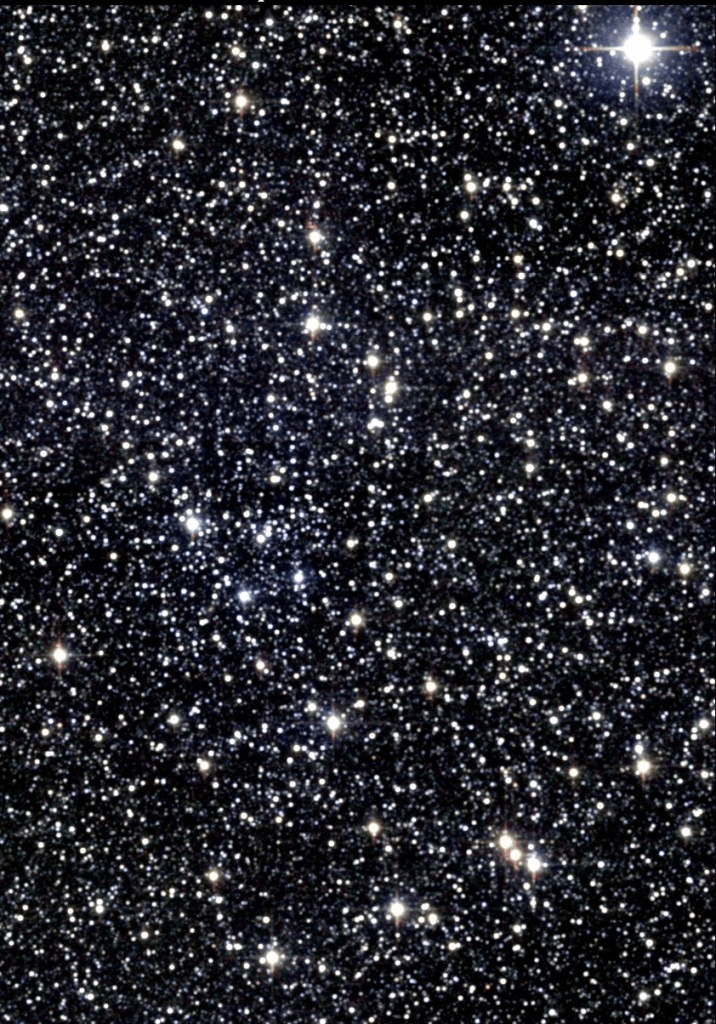
M26 spans about 22 light-years across and is estimated to be about 89 million years old. The brightest star in the cluster has an apparent magnitude of 11.9. There is a zone of low star density near the cluster’s core, possibly due to a cloud of matter between the stars obscuring them.
NGC 6712
NGC 6712 is a globular cluster in the constellation Scutum. It has a visual magnitude of 8.69 and is approximately 22,500 light-years from the Solar System.
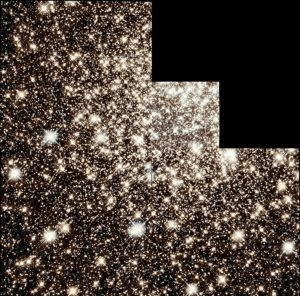
This cluster was likely discovered by the French astronomer Le Gentil in July 1749. Le Gentil described these objects as a “true nebula.” NGC 6712 was later independently discovered by the German-born astronomer William Herschel on June 16, 1784. Herschel classified this cluster as a round nebula. John Herschel was the first to describe this object as a globular star cluster around 1830.
IC 1295
IC 1295 is a planetary nebula in the constellation Scutum. It has an apparent magnitude of 12.7 and is approximately 3,300 light-years from Earth.
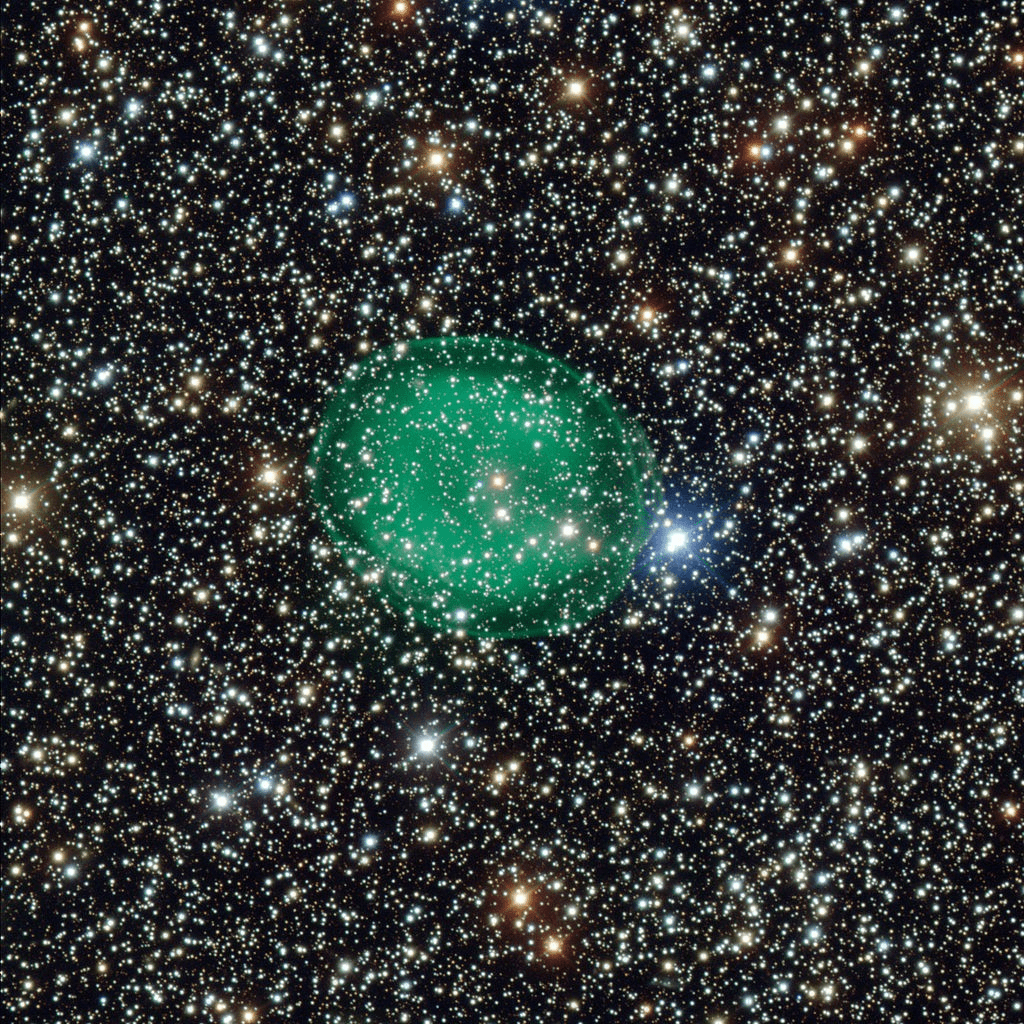
The central star is a white dwarf currently in the process of shedding its outer layers.
RSGC1
RSGC1 is an open star cluster in the Milky Way, located approximately 22,000 light-years away in the direction of the constellation Scutum. It is a young, massive star cluster with 12 red supergiants, one yellow supergiant, and one intermediate star.
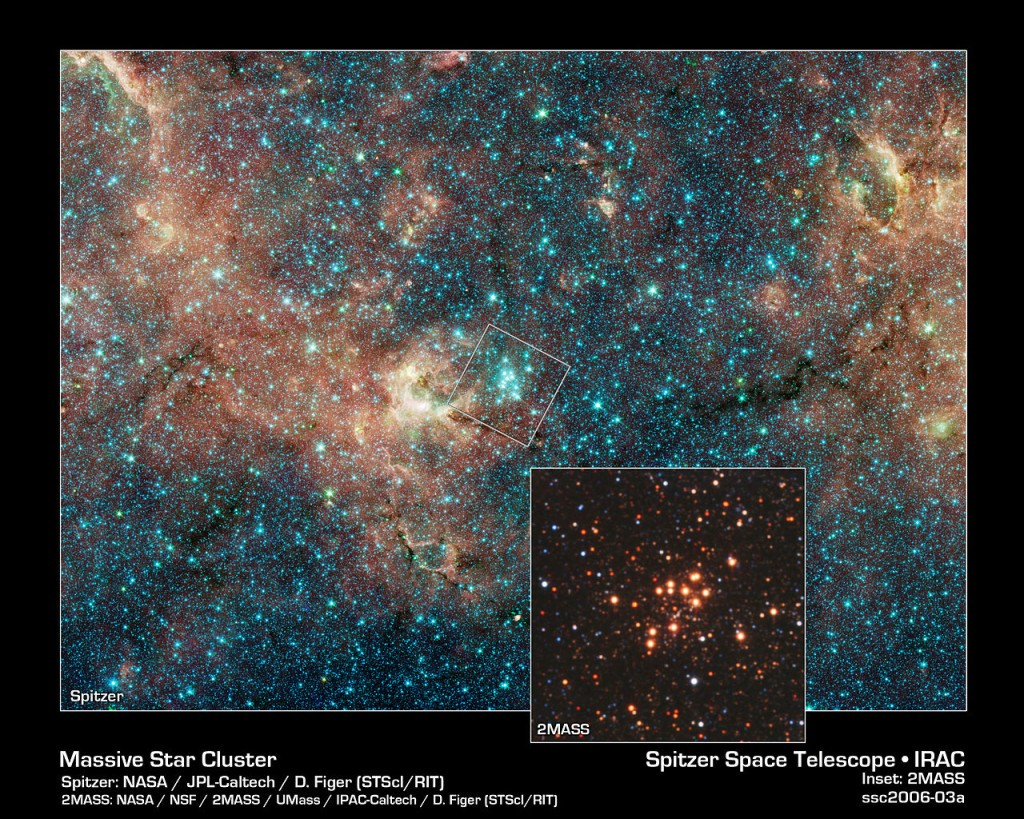
This cluster cannot be seen in visible light; it was discovered in 2006 using data from several infrared surveys. It is considered one of the most massive open clusters known in our galaxy.
Alicante 8 – RSGC4
Alicante 8 is another massive young open cluster in the constellation Scutum, also one of the largest known open clusters in the Milky Way. Like the nearby RSGC1, this cluster cannot be observed in visible light. It was discovered recently in 2010. This cluster contains 8 to 13 red supergiants. Alicante 8 is approximately 20,000 light-years from Earth. Its estimated age is 16-20 million years.
RSGC3
RSGC3 is also a large, young open cluster undetectable in visible light. It was discovered in 2010. This cluster contains 8 to 14 red supergiants. It is 22,000 light-years away from Earth. At least 30 other red supergiants have been detected in the cluster’s vicinity, 7 of which form the cluster Alicante 7.
Stephenson 2 – RSGC2
Stephenson 2 is another young star cluster in Scutum that cannot be observed in visible light. It is approximately 20,000 light-years away. It is the home of Stephenson 2-18, one of the largest stars known. This star cluster was discovered in 1990 using data obtained from an infrared survey. It is known to contain 26 red supergiants. The cluster is estimated to be 14-20 million years old.
Mercer 3
Mercer 3 is a globular cluster in the constellation Scutum. It is heavily obscured as it is embedded in the disk of the Milky Way. This cluster is about 12 billion years old. It was discovered in an infrared survey in 2008.
 Khanh's Gallery
Leave a comment