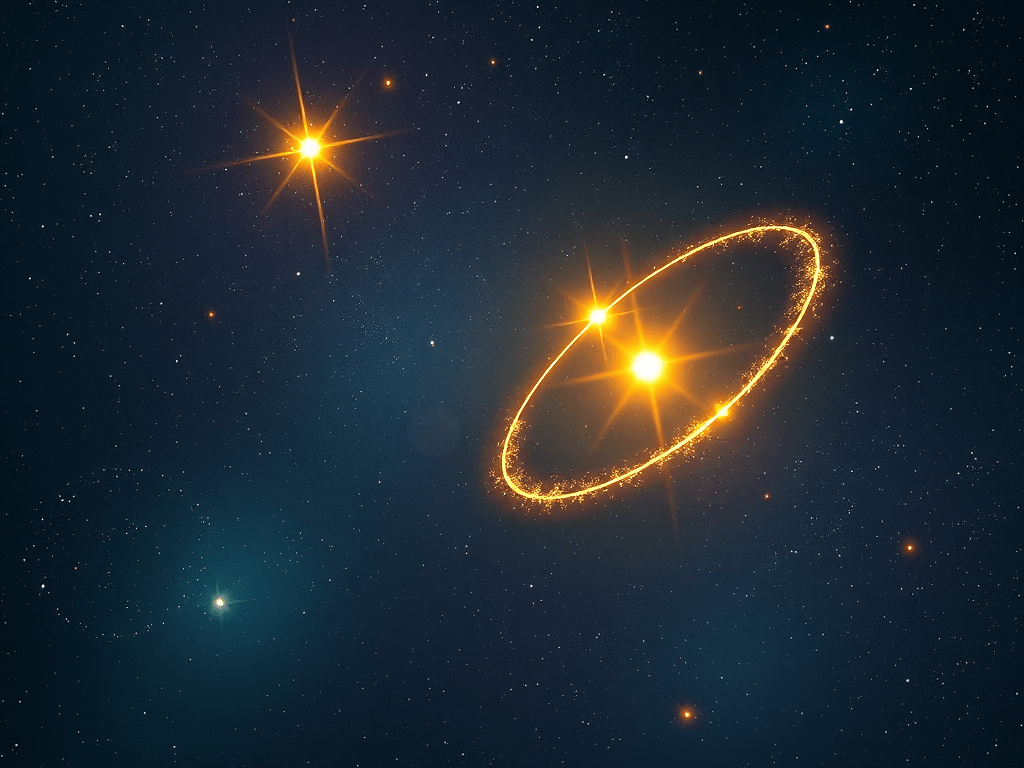
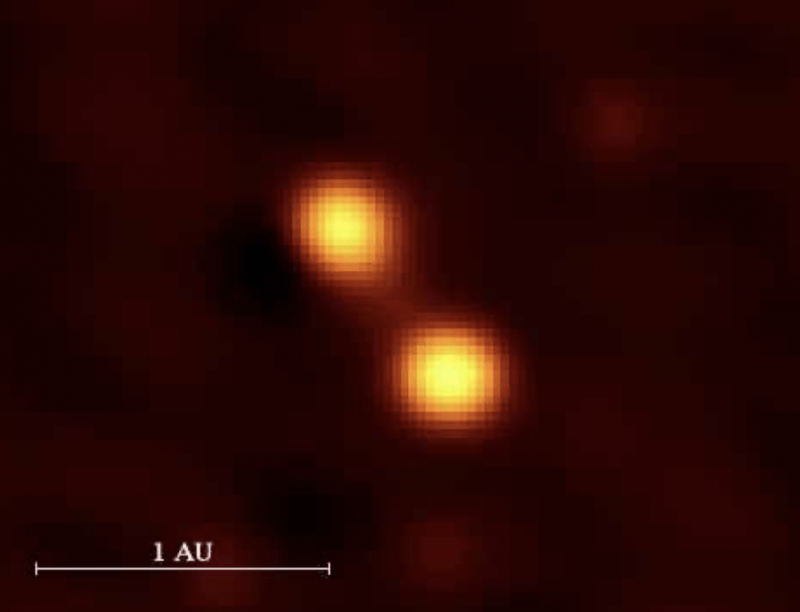
Capella is a prominent feature of the Northern Hemisphere’s winter celestial sphere. Designated as Alpha Aurigae, it serves as the luminary of the constellation Auriga (The Charioteer). While appearing to the naked eye as a single brilliant point of source, Capella is, in reality, a quadruple star system (comprising two binary pairs). Notably, the primary pair consists of yellow giant stars that are significantly larger and more luminous than our Sun, located at a distance of approximately 42 light-years from Earth.
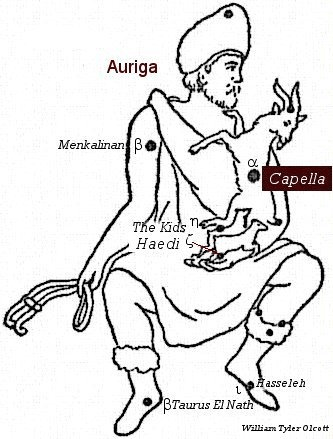
Observational Astronomy: Locating Capella
For observers in the Northern Hemisphere, winter offers optimal viewing conditions as this yellow giant remains visible throughout the night. During the autumn months, when the star is positioned at a low altitude near the northern horizon, its light traverses a thicker layer of Earth’s atmosphere. This results in intense atmospheric scintillation, causing the star to twinkle rapidly and exhibit chromatic dispersion (flashing red, blue, and green).
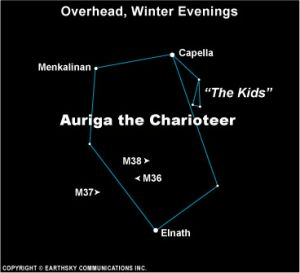
As noted, Capella is the brightest vertex of the characteristic pentagon asterism that defines the constellation Auriga. While visualizing the mythological figure of a Charioteer may prove abstract, identifying this pentagonal geometric arrangement is relatively straightforward for amateur astronomers.
Astrophysical Properties
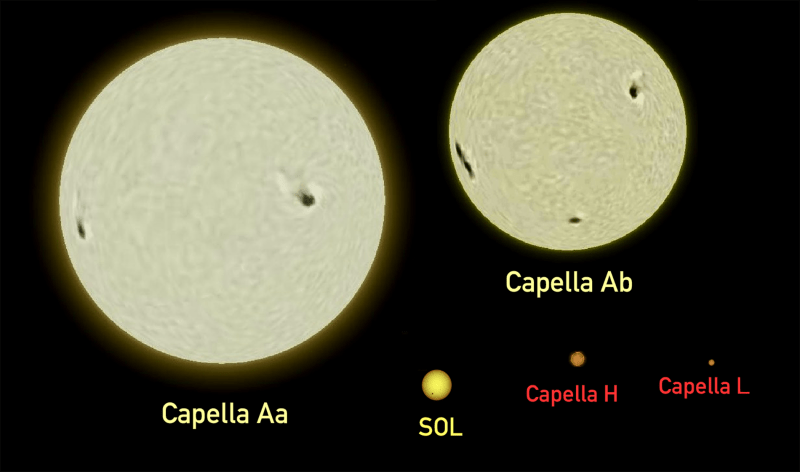
Although it appears as a singular object to the unaided eye, Capella is a complex multiple-star system. The primary component is designated Capella A. Cataloged visual companions within a few arcminutes are designated B through R (specifically B, C, D, E, F, G, H, I, L, M, N, O, P, Q, and R). It is uncertain whether all these faint stars are gravitationally bound to the system or if they share a common origin within the same stellar nursery (molecular cloud).
Capella A is classified as a spectroscopic binary system, comprising components Aa and Ab. Both stars possess diameters approximately 10 times that of the Sun and exhibit luminosities of 80 and 50 times more than solar luminosities, respectively. Due to their close proximity, they cannot be resolved as separate objects through standard optical telescopes.
Both Capella Aa and Ab are Yellow Giant stars (Spectral Type G) that have evolved off the main sequence. This evolutionary stage occurs because more massive stars possess higher internal pressures and core temperatures, resulting in accelerated nuclear fusion and shorter lifespans. Currently, these stars are in a transitional phase, cooling and expanding from their former hot, main-sequence states towards the Red Giant Branch. Despite this evolution, their current effective surface temperatures remain comparable to that of the Sun.
History and Mythology
The constellation Auriga has relatively sparse connections to standard Greek mythology, often linked loosely to Poseidon. One prominent interpretation identifies the Charioteer as Erichthonius, an ancient, lame King of Athens credited with the invention of the quadriga (four-horse chariot). Given the constellation’s association with herdsmen in various cultures, the designation of Capella as the “Goat Star” is thematically consistent.
In his seminal work Star Names: Their Lore and Meaning, Richard Hinckley Allen notes that ancient Arabs referred to Capella by a title translating to “The Driver,” implying a shepherd driving a flock across the sky. This “flock” likely referred to the nearby open star cluster, the Pleiades (M45). In the context of early Bedouin astronomy, the livestock were likely camels rather than sheep or goats. Capella also held significance in Ancient Egypt, appearing on the Dendera Zodiac depicted as a mummified cat.
In Chinese Astronomy, Capella and four other stars in Auriga form the asterism known as “The Five Chariots” (Wu Che). The other four components are Beta, Theta, Kappa, and Gamma Aurigae (the latter being El Nath, which is now formally designated as Beta Tauri).
Celestial Coordinates
- Right Ascension (RA): 5h 16m 41.4s
- Declination (Dec): +45° 59′ 53″.
 Khanh's Gallery
Leave a comment