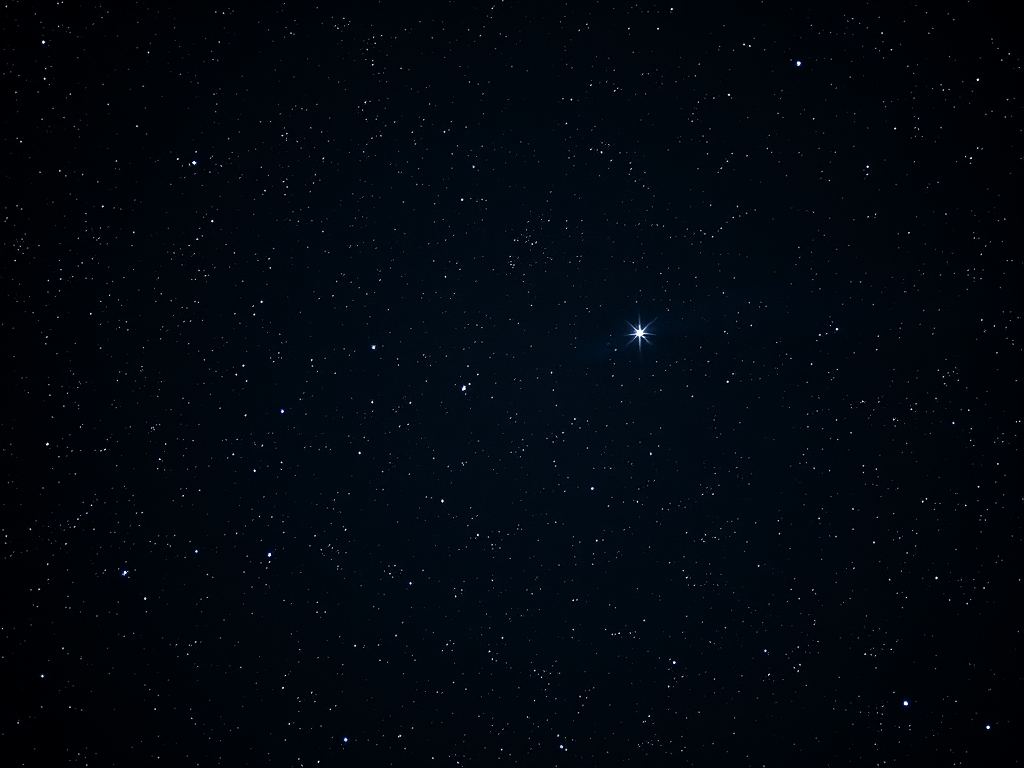
The constellation Ursa Major is located in the northern sky. Its name means “the great bear” or “the larger bear” in Latin. The smaller bear is represented by the constellation Ursa Minor.
Ursa Major is the largest northern constellation and the third-largest constellation in the entire sky. Its brightest stars form the Big Dipper asterism, one of the most recognizable shapes in the sky, also known as The Plough. Ursa Major is famous in most world cultures and is associated with numerous myths. It is one of the constellations cataloged by the Greek astronomer Ptolemy in the 2nd century. In Greek mythology, it is linked to Callisto, a nymph turned into a bear by Zeus’s jealous wife, Hera.
The constellation Ursa Major contains several notable stars and famous deep-sky objects. These include the Pinwheel Galaxy (M101), Bode’s Galaxy (M81), the Cigar Galaxy (M82), and the Owl Nebula (M97).
LOCATION OF URSA MAJOR IN THE SKY
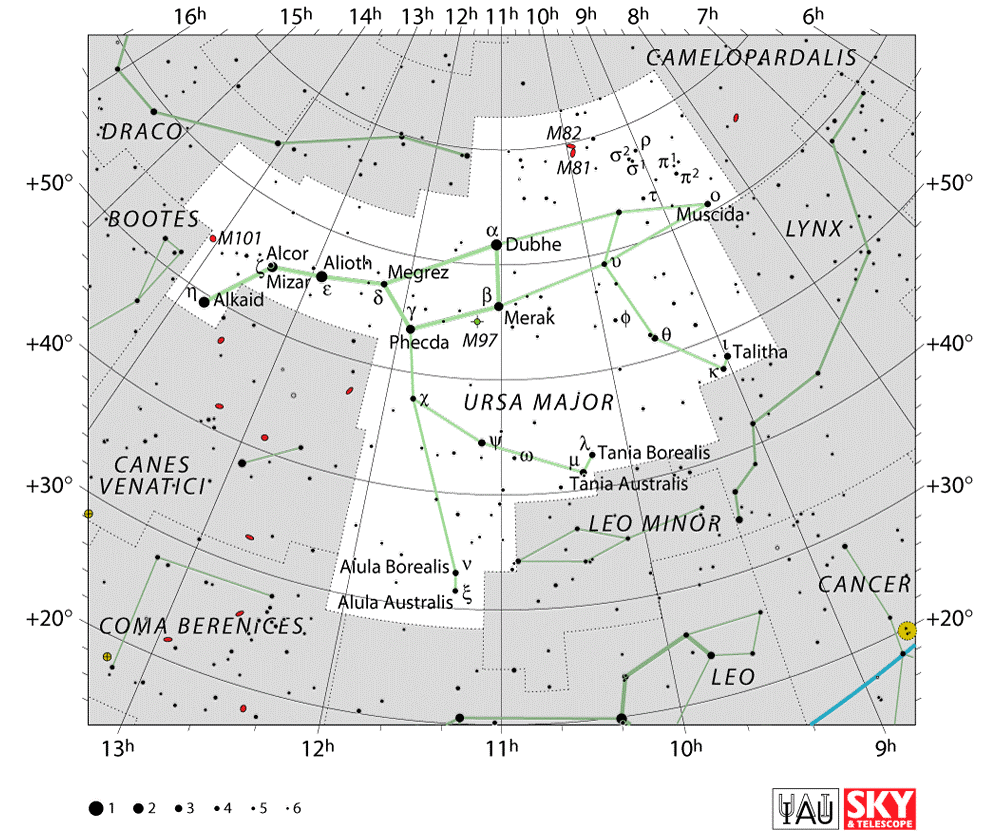
Ursa Major is the third-largest constellation in the sky, occupying an area of 1280 square degrees. It is located in the second quadrant of the northern hemisphere (NQ2) and can be seen at latitudes between +90° and -30°. Neighboring constellations are Draco, Camelopardalis, Lynx, Leo Minor, Leo, Coma Berenices, Canes Venatici, and Boötes.
Ursa Major belongs to the Ursa Major Family of constellations, along with Boötes, Camelopardalis, Canes Venatici, Coma Berenices, Corona Borealis, Draco, Leo Minor, Lynx, and Ursa Minor.
Ursa Major contains seven Messier objects: Messier 40 (M40, Winnecke 4), Messier 81 (M81, NGC 3031, Bode’s Galaxy), Messier 82 (M82, NGC 3034, Cigar Galaxy), Messier 97 (M97, NGC 3587, Owl Nebula), Messier 101 (M101, NGC 5457, Pinwheel Galaxy), Messier 108 (M108, NGC 3556), and Messier 109 (M109, NGC 3992). It also contains 13 stars with confirmed planets.
The brightest star in the constellation is Alioth (Epsilon Ursae Majoris), with an apparent magnitude of 1.76.
Ursa Major contains 22 stars with officially designated names. The names approved by the International Astronomical Union (IAU) are: Alcor, Alioth, Alkaid, Alkaphrah, Alula Australis, Alula Borealis, Aniara, Chalawan, Dombay, Dubhe, Intercrus, Liesma, Megrez, Merak, Mizar, Muscida, Násti, Phecda, Taiyangshou, Talitha, Tania Australis, and Tania Borealis.
There are two meteor showers associated with the constellation: the Alpha Ursae Majorids and the Leonids-Ursids.
ORIGIN OF THE NAME URSA MAJOR
Ursa Major is a well-known constellation with significance in many cultures. It is one of the oldest constellations in the sky, with a history dating back to ancient times. The constellation is referenced in Homer and the Bible. Many stories and legends across the globe associate Ursa Major with a bear.
Ancient Greeks associated this constellation with the myth of Callisto, a beautiful nymph who took a vow of chastity to the goddess Artemis. One day, Zeus saw the nymph and fell in love. The two had a son named Arcas. Artemis expelled Callisto when she discovered the nymph’s pregnancy and broken vow.
However, it was Zeus’s jealous wife, Hera, who disliked the betrayal of her husband the most, causing even greater suffering. Furious at Zeus’s infidelity, she turned Callisto into a bear.
Callisto lived as a bear for the next 15 years, wandering the forests and always fleeing from hunters. One day, her son Arcas was hunting in the forest and the two came face to face. When the bear saw her son, Arcas quickly drew his spear, terrified.
Seeing the scene from Mount Olympus, Zeus intervened to prevent a tragedy. He sent a whirlwind that carried both Callisto and Arcas into the heavens, where he turned Arcas into the constellation Boötes (The Herdsman) and Callisto into Ursa Major. (In another version, Arcas becomes the constellation Ursa Minor). This angered Hera even more, and she persuaded her foster parents, Oceanus and Tethys, never to let the bear bathe in the northern waters. According to legend, this is why Ursa Major never sets below the horizon at mid-northern latitudes (it is circumpolar).
In another version of the story, it was not Hera but Artemis who turned Callisto into a bear. Artemis did this to punish the nymph for breaking her vow of chastity to the goddess. Many years later, Callisto and Arcas were captured in the forest and brought to King Lycaon as a gift. The mother and son escaped into the temple of Zeus, where trespassing was punishable by death, but the god intervened and saved them, placing both in the sky.
There is a completely different Greek myth related to Ursa Major involving Adrastea. Adrastea was one of the nymphs who cared for Zeus when he was very young. Zeus’s father, the Titan Cronus, was told by a prophecy that one of his children would eventually overthrow him. Fearing the prophecy, Cronus swallowed all his children as soon as they were born. Rhea, Zeus’s mother, smuggled her youngest child to the island of Crete, where the nymphs Adrastea and Ida cared for the infant Zeus for a year. In this version of the myth, Ida is associated with the constellation Ursa Minor. Amalthea, the goat that nursed Zeus, was placed in the sky as the bright star Capella in the constellation Auriga. The prophecy eventually came true; Zeus overthrew Cronus and freed his brothers Hades and Poseidon and his sisters Demeter, Hera, and Hestia.
The Romans called the constellation Septentrio, or “seven plough oxen,” even though only two of the seven stars represented oxen, while the others formed a wagon.
Ursa Major is associated with many different shapes in the sky in various cultures, ranging from a camel, shark, and skunk to a sickle, bushel, and canoe. The Chinese know the seven brightest stars as Beidou (Northern Dipper).
In Hindu mythology, the brightest stars of Ursa Major represent the Seven Sages, and the constellation is called Saptarshi. The sages mentioned are Bhrigu, Atri, Angirasa, Vasishta, Pulastya, Pulalaha, and Kratu.
In some Native American tales, the bowl of the Ursa Major constellation represents a large bear, and the stars marking the handle are warriors chasing it. Because the constellation hangs low in the sky in autumn, legend says that the bear’s blood from being wounded causes the leaves to turn red.
In more recent American history, the Big Dipper played an important role in the Underground Railroad, as its position in the sky helped enslaved people find their way north. There were many songs spread among enslaved people in the South telling them to “Follow the Drinking Gourd” to find a better life.
MAJOR STARS IN URSA MAJOR
ASTERISM – THE BIG DIPPER (THE PLOUGH)
The Big Dipper is one of the most recognizable asterisms in the sky. It holds significance in many different cultures. The Ursa Major constellation is also very useful in navigation because it points the way to Polaris, the North Star (Alpha Ursae Minoris), which is part of a famous celestial body [Ursa Minor].
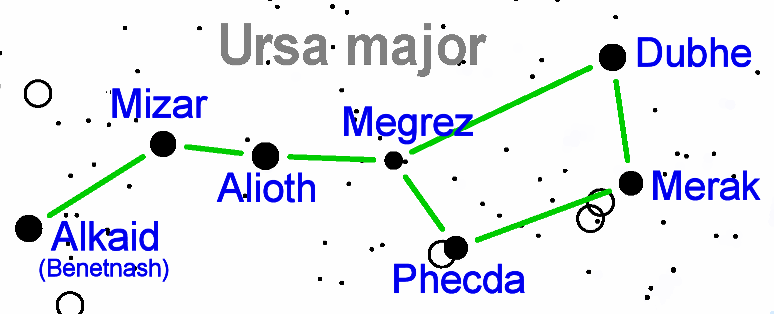
If you follow an imaginary line from Merak to Dubhe and continue the arc, you will eventually reach the North Star.
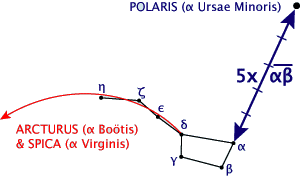
Similarly, an imaginary line extending along the handle of the Dipper leads to the bright star Arcturus, the bear guard in the constellation Boötes (The Herdsman). If you follow the curve further (“speed on to Spica”), you will find Spica, the brightest star in the constellation Virgo and also one of the brightest stars in the sky.
The seven stars forming the Big Dipper are Dubhe (Alpha UMa), Merak (Beta UMa), Phecda (Gamma UMa), Megrez (Delta UMa), Alioth (Epsilon UMa), Mizar (Zeta UMa), and Alkaid (Eta UMa).
Alioth – Epsilon Ursae Majoris (ε UMa)
Alioth is the brightest star in Ursa Major and the 31st brightest star in the night sky. It has an apparent magnitude of 1.76 and is approximately 81 light-years away. The traditional name of the star comes from the Arabic alyat, meaning “fat tail of a sheep.” Alioth is the star in the bear’s tail closest to the bear’s body.
Alioth belongs to the Ursa Major Moving Group (Collinder 285), a group of stars that includes most of the brightest stars in Ursa Major. The stars in the group share common velocities in space and are believed to have a common origin. The Ursa Major Moving Group was discovered by the English astronomer Richard A. Proctor in 1869, who realized that all the stars of the Big Dipper, except Alkaid and Dubhe, share a proper motion heading towards a common point in the constellation Sagittarius. Other stars like Alpha Coronae Borealis, Beta Aurigae, Delta Aquarii, Gamma Leporis, and Beta Serpentis are also members of the group.
Alioth belongs to the spectral class A0pCr. The “p” stands for peculiar, because the light spectrum of the star is similar to that of Alpha-2 Canum Venaticorum variables. Alioth exhibits fluctuations in its spectral lines with a period of 5.1 days.
Dubhe – Alpha Ursae Majoris (α UMa)
Dubhe has an apparent magnitude of 1.79 and is 123 light-years from the Solar System. It is the second-brightest star in Ursa Major. The name Dubhe comes from the Arabic zahr al-dubb al-akbar, meaning “back of the greater bear,” or simply “bear”. Dubhe does not belong to the Ursa Major Moving Group.
Dubhe is a giant star belonging to spectral class K1 II-III. It is a spectroscopic binary. Its companion is a main-sequence star belonging to spectral class F0 V. It completes an orbit around the brighter star every 44.4 years at a distance of 23 astronomical units (AU). There is another binary system separated from the main pair by 90,000 AU, making Alpha Ursae Majoris a four-star system.
Merak – Beta Ursae Majoris (β UMa)
The name Merak comes from the Arabic al-maraqq, meaning “the loins.” Beta Ursae Majoris is a main-sequence star, approximately 79.7 light-years away, with a visual magnitude of 2.37. It belongs to spectral class A1 V. The star has a debris disk of dust orbiting it, a disk with a mass of 0.27% that of Earth. Beta Ursae Majoris has a mass 2.7 times that of the Sun, a radius 2.84 times larger, and is 68 times more luminous. It belongs to the Ursa Major Moving Group and is a suspected variable star.
Alkaid (Benetnash) – Eta Ursae Majoris (η UMa)
Alkaid is the easternmost star in the Big Dipper asterism. It is also known as Elkeid and Benetnash. It is a young main-sequence star belonging to spectral class B3 V, approximately 101 light-years away. It has an apparent magnitude of 1.85 and is the third-brightest star in the constellation and the 35th brightest in the night sky.
Alkaid is notable for being one of the hottest stars visible without binoculars. It has a surface temperature of 20,000 Kelvins. The star has a mass 6 times that of the Sun and is about 700 times more luminous than the Sun. Like Dubhe, Alkaid does not belong to the Ursa Major Moving Group.
The star’s traditional names, Alkaid and Benetnash (or Benetnasch), originate from the Arabic phrase qa’id binat na’sh, meaning “the leader of the daughters of the bier.” The three stars marking the handle of Ursa Major represent three mourners in a funeral procession, while the stars forming the bowl represent the bier. The name Alkaid specifically means “the leader.” Although it is the third-brightest star in Ursa Major, Alkaid was designated Eta Ursae Majoris because Johannes Bayer named the stars of the Big Dipper from west to east (Dubhe to Alkaid) rather than by brightness.
Phecda – Gamma Ursae Majoris (γ UMa)
Gamma Ursae Majoris is the lower-left star in the bowl of the Ursa Major constellation. It belongs to the Ursa Major Moving Group. The star’s traditional name, Phecda (or Phad), originates from the Arabic phrase fakhdh al-dubb, meaning “thigh of the bear.”
Gamma UMa is a main-sequence star of type A0 Ve. It has a visual magnitude of 2.438 and is 83.2 light-years away. The “-e” in its classification indicates it is an Ae star, a star surrounded by an envelope of gas that adds emission lines to its spectrum. Phecda’s estimated age is 300 million years. The star lies astrometrically close to the Mizar-Alcor system, only 8.55 light-years away.
Megrez – Delta Ursae Majoris (δ UMa)
Megrez, Delta Ursae Majoris, is the faintest of the seven bright stars forming the Big Dipper asterism. It is a main-sequence star belonging to spectral class A3 V. It has a visual magnitude of 3.312 and is 58.4 light-years from the Solar System. It is 14 times more luminous than the Sun and has a mass 63% greater. The star emits an excess of infrared radiation, indicating a debris disk in its orbit. The star’s name, Megrez, comes from the word al-maghriz in Arabic, meaning “the base” (as in, the base of the bear’s tail).
Mizar – Zeta Ursae Majoris (ζ UMa)
Zeta Ursae Majoris is a system consisting of two binary stars. It can be found in the handle of the Big Dipper – it is the second star from the end. The name Mizar originates from mizar in Arabic, meaning “girdle” or “waistband.” Mizar has an apparent magnitude of 2.23 and is 82.8 light-years away. This was the first double star to be photographed. The American inventor and photographer John A. Whipple and astronomer George P. Bond photographed the binary system in 1857 using a wet collodion plate and the 15-inch refractor telescope at Harvard College Observatory. Bond had previously also photographed the star Vega in the constellation Lyra in 1850.
OTHER NOTABLE STARS:
Alcor (80 Ursae Majoris)
Alcor is the visual companion to Mizar. It belongs to spectral class A5V. The two binary stars are often known by the name “Horse and Rider.” Alcor has a visual magnitude of 3.99 and is 81.7 light-years from the Solar System. It is also called Saidak (“the test”), Suha (“the neglected one” or “the forgotten one”), and Arundhati in Indian culture. Alcor was discovered to be a binary system in 2009. Both Mizar and Alcor belong to the Ursa Major Moving Group. The estimated distance between the two stars is 1.1 light-years.
W Ursae Majoris
W Ursae Majoris is the prototype for a class of stars known as W Ursae Majoris variables. It is a binary system consisting of two stars close together in a circular orbit with a period of 0.3336 days. The stars are so close that their outer envelopes physically touch each other (contact binary). Each star eclipses the other during every orbital cycle, leading to a decrease in brightness. The apparent magnitude of the system varies between 7.75 and 8.48. Both stars belong to spectral class F8V.
Messier 40 (M40, Winnecke 4, WNC 4)
Winnecke 4 is another double star in the constellation Ursa Major. It was originally cataloged by Charles Messier as a Messier object in 1764 while he was searching for a nebula that Johann Hevelius reported seeing in the area. Instead of finding a nebula, Messier cataloged this double star. German astronomer Friedrich August Theodor Winnecke rediscovered this star in 1863, and it was subsequently named after him. Winnecke 4 has an apparent magnitude varying between 9.65 and 10.10 and is approximately 510 light-years away.
47 Ursae Majoris
47 Ursae Majoris is a main-sequence star belonging to spectral class G1V. It is 45.9 light-years from Earth. The star is a solar analog; it has a similar mass and is slightly hotter than the Sun, with about 110% of the Sun’s iron abundance. It has an apparent magnitude of 5.03. In 1996, a planet at least 2.53 times the mass of Jupiter was discovered orbiting this star. Two other planets were discovered in the system in 2002 and 2010.
Alula Borealis and Alula Australis – Nu (ν) and Xi (ξ) Ursae Majoris – “The First Leap”
Nu Ursae Majoris is another double star, one visible to the naked eye. It has an apparent magnitude of 3.490 and is 399 light-years from the Solar System. It is a giant star belonging to spectral class K3 III with a radius 57 times that of the Sun and 775 times the Sun’s luminosity. The star’s traditional name, Alula Borealis, originates from the Arabic al-Ūlā, meaning “the first (leap),” and the Latin borealis, meaning “northern.”
Xi Ursae Majoris, or Alula Australis, is the southern star of “the first leap.” In fact, it was the first binary star system discovered by Sir William Herschel in 1780. Xi Ursae Majoris consists of two main-sequence dwarfs belonging to spectral class G0 Ve. The system is only 29 light-years away. The brighter component has an apparent magnitude of 4.32 and the fainter is 4.84. The combined visual magnitude of the system is 3.79. Xi Ursae Majoris is classified as an RS Canum Venaticorum variable star. RS Canum Venaticorum variables are close binary stars with large starspots caused by the stars’ active chromospheres. These spots cause brightness variations of around 0.2 magnitudes. In some cases, the brightness fluctuations are caused by the stars eclipsing each other. Each of the two main components in the Xi Ursae Majoris system is itself a spectroscopic binary, and there is a low-mass companion. Xi Ursae Majoris is also notable as the first binary star to have its orbit calculated, in 1828. Nu and Xi Ursae Majoris are the first pair of stars named by ancient Arabs as “the gazelle’s first leap.”
Tania Borealis and Tania Australis – Lambda (λ) and Mu (μ) Ursae Majoris – “The Second Leap”
Lambda Ursae Majoris is a star belonging to spectral class A2 IV, meaning it is evolving into a giant star as its supply of hydrogen is depleted. The star has an apparent magnitude of 3.45 and is approximately 138 light-years away. The star’s traditional name, Tania Borealis, means “Northern (star) of the Second (leap).”
Mu Ursae Majoris, or Tania Australis, is the southern star of this pair. It is a red giant, belonging to spectral class M0, located approximately 230 light-years away. It has a visual magnitude of 3.06 and is classified as a semiregular variable star, with brightness fluctuations ranging between 2.99 and 3.33. Mu Ursae Majoris has a spectroscopic companion located 1.5 AU away.
Talitha Borealis and Talitha Australis – Iota (ι) and Kappa (κ) Ursae Majoris – “The Third Leap”
Iota Ursae Majoris is a star system consisting of two binary stars, a white subgiant belonging to spectral class A7 IV, essentially a binary system, and another pair of 9th and 10th magnitude stars. When component B was first discovered in 1841, the two binary stars were 10.7 arcseconds apart. The distance between them has decreased significantly since then, and is now only 4.5 arcseconds. The two components orbit each other every 818 years. Iota Ursae Majoris is 47.3 light-years from the Solar System.
Kappa Ursae Majoris is another binary star in Ursa Major, consisting of two main-sequence A-type dwarfs with visual magnitudes of 4.2 and 4.4. The system has an apparent magnitude of 3.60 and is 358 light-years away.
Muscida – Omicron (ο) Ursae Majoris Omicron
Ursae Majoris is a multiple star system located 179 light-years away. It belongs to spectral class G4 II-III, meaning it lies somewhere between a bright giant and a giant in terms of evolution. It has an apparent magnitude of 3.35. The star’s traditional name, Muscida, means “the muzzle.”
Groombridge 1830
Groombridge 1830 is a dwarf star belonging to spectral class G8V, only 29.7 light-years away. It was cataloged by the English astronomer Stephen Groombridge in the early 19th century in his Catalog of Circumpolar Stars, published posthumously in 1838. When discovered, Groombridge 1830 was the star with the highest known proper motion. It fell to third place with the discovery of Kapteyn’s Star in the constellation Pictor and Barnard’s Star in Ophiuchus. Like Kapteyn’s Star, Groombridge 1830 is a halo star, a star that appears to be moving in the opposite direction to the galaxy’s rotation because it does not follow the Milky Way’s rotation. Halo stars are typically metal-poor because they were created in an earlier era of the galaxy. Most halo stars are located above or below the galactic plane and are believed to be at least 10 billion years old. They have highly eccentric orbits and high space velocities.
Lalande 21185
Lalande 21185 is a red dwarf (spectral type: M2V) only 8.31 light-years from the Sun. It has an apparent magnitude of 7.520 and cannot be seen with the naked eye. It is the fourth-closest system to our Solar System, after Alpha Centauri, Barnard’s Star, and Wolf 359. Within another 19,900 years, it will come within 4.65 light-years of the Sun. Lalande 21185 belongs to the BY Draconis class of variables and is a known X-ray source.
Psi Ursae Majoris
Psi Ursae Majoris is an orange giant, belonging to spectral class K1 III. It has a visual magnitude of 3.01 and is 144.5 light-years away. The Chinese call it Tien Tsan or Ta Tsun, meaning “extremely honorable.”
DEEP SKY OBJECTS IN URSA MAJOR
Bode’s Galaxy – Messier 81 (M81, NGC 3031)
Messier 81 is a large, bright spiral galaxy, 11.8 million light-years away.
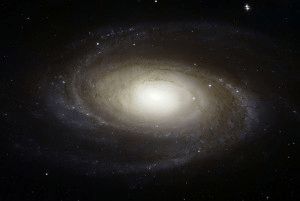
Due to its brightness and relative proximity – it has an apparent magnitude of 6.94 – M81 is a popular target for both beginners and professional astronomers. The apparent size of the galaxy is 26.9 x 14.1 arcminutes. Only one supernova has been discovered in it: SN 1993J, in March 1993. Bode’s Galaxy was discovered by the German astronomer Johann Elert Bode in 1774. In 1779, Charles Messier independently identified the galaxy and included it in his catalog. Bode’s Galaxy is the largest of the 34 galaxies belonging to the M81 Group, one of the galaxy groups located in Ursa Major. The galaxy can be seen about 10 degrees northwest of the star Dubhe (Alpha Ursae Majoris). Bode’s Galaxy interacts with neighboring galaxies Messier 82 and the smaller NGC 3077. As a result of the interaction between the galaxies, hydrogen gas has been stripped from all three and gaseous filament structures have formed within the group. A complex system of gravitational interactions is causing strong star formation activity in the centers of Messier 82 and NGC 3077.
The Cigar Galaxy – Messier 82 (M82, NGC 3034)
Messier 82 is an edge-on starburst galaxy located 11.5 million light-years away. It has an apparent magnitude of 8.41.
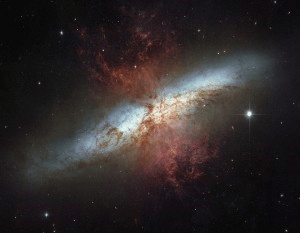
Star formation occurs in the galaxy’s core ten times faster than star formation activity in the entire Milky Way. M82 is also five times brighter than our galaxy. 197 large star clusters were discovered by Hubble in the central region of the galaxy in 2005. M82 emits excess infrared radiation and is the brightest galaxy in the sky when observed in infrared light. The Cigar Galaxy is thought to have had at least one encounter with the neighboring galaxy Messier 81, and as a result, a large amount of gas was eventually funneled into its core over the last 200 million years. Consequently, star formation activity in this galaxy has increased tenfold compared to most other galaxies. M82 was discovered by Johann Elert Bode on December 31, 1774, along with M81. Bode originally described both as nebulous patches.
The Owl Nebula – Messier 97 (M97, NGC 3587)
The Owl Nebula is a planetary nebula approximately 2,600 light-years from the Solar System. It has an apparent magnitude of 9.9.
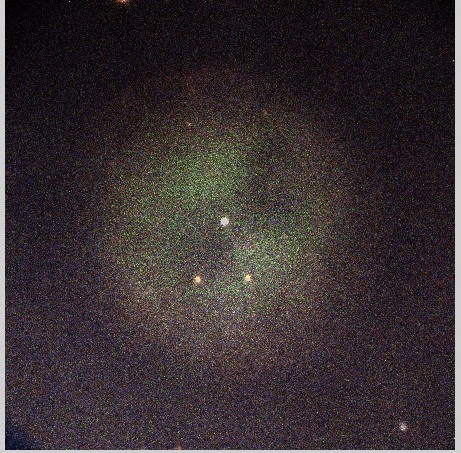
This nebula was first discovered by the French astronomer Pierre Méchain in 1781. It is estimated to have formed about 8,000 years ago. The Owl Nebula has a 16th-magnitude central star. It gets its name because it has an appearance resembling an owl’s face when viewed through a large telescope.
The Pinwheel Galaxy – Messier 101 (M101, NGC 5457)
The Pinwheel Galaxy is a grand design spiral galaxy viewed face-on. It has an apparent magnitude of 7.86 and is 20.9 million light-years from Earth.
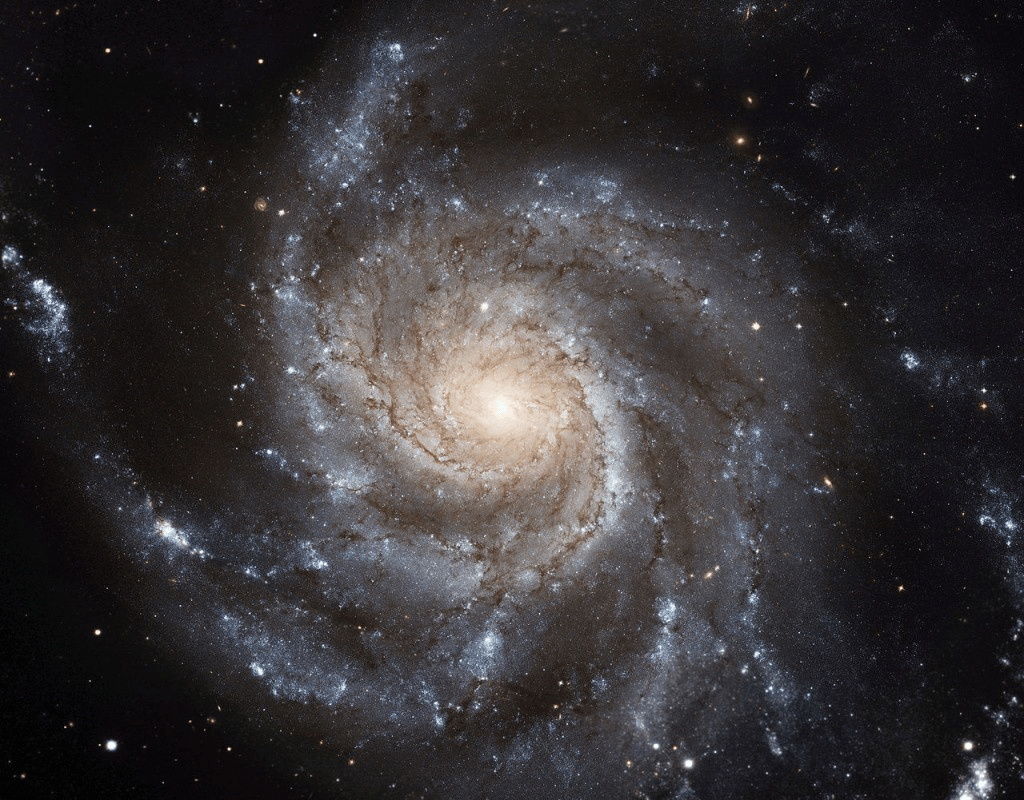
It was discovered by Pierre Méchain in 1781 and Charles Messier subsequently included it in his catalog. It was one of the last entries. A Type Ia supernova (a violent explosion of a white dwarf star), SN 2011fe, was observed in the galaxy in August 2011. Pierre Méchain described Messier 101 as a “nebula without stars, very obscure and pretty large, 6′ to 7′ in diameter, between the left hand of Boötes and the tail of the Great Bear. It is difficult to distinguish when one lights the [graticule] wires.” The Pinwheel Galaxy has a diameter of approximately 170,000 light-years, 70% larger than the Milky Way Galaxy. It contains several large, bright H II regions, filled with hot, bright, newly formed stars. M101 has five notable companion galaxies: NGC 5474, NGC 5204, NGC 5477, NGC 5585, and Holmberg IV. The grand design shape of the Pinwheel Galaxy is suspected to be the result of interaction between the galaxy and its companions.
Messier 108 (M108, NGC 3556)
Messier 108 is a barred spiral galaxy, discovered by Pierre Méchain in 1781.
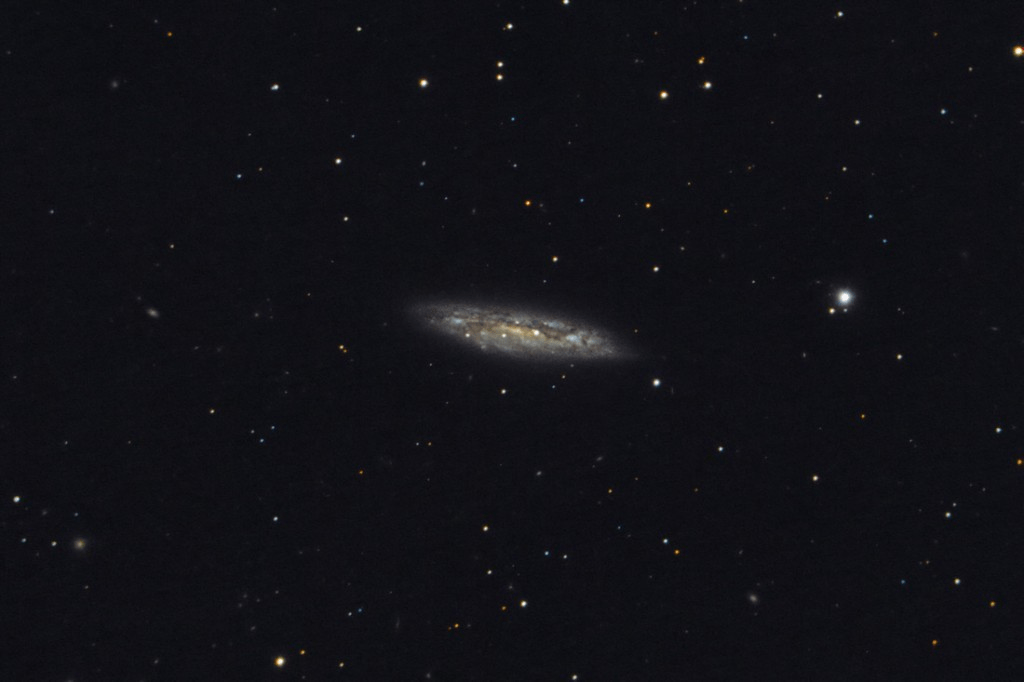
From our perspective, this galaxy is seen almost edge-on. M108 is an isolated member of the Ursa Major Cluster, a galaxy cluster located within the Virgo Supercluster. M108 contains about 290 globular clusters and 83 X-ray sources. The galaxy has a visual magnitude of 10.7 and is 45,000 light-years away. A Type 2 supernova, 1969B, was observed in M108 in 1969.
Messier 109 (M109, NGC 3992)
Messier 109 is a barred spiral galaxy in the constellation Ursa Major. It is located southeast of the star Phecda (Gamma Ursae Majoris).
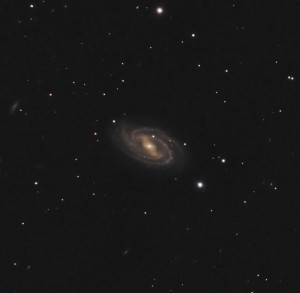
The galaxy has an apparent magnitude of 10.6 and is 83.5 million light-years away. Like other notable galaxies in Ursa Major, M109 was discovered by Pierre Méchain in 1781. Charles Messier included it in his catalog two years later. A Type Ia supernova, SN 1956A, was seen in the galaxy in 1956. To date, it is the only supernova observed in M109. M109 has at least three satellite galaxies: UGC 6923, UGC 6940, and UGC 6969. It is the brightest galaxy in the M109 Group, a large group containing more than 50 galaxies in Ursa Major.
NGC 5474
NGC 5474 is a peculiar dwarf galaxy in the constellation Ursa Major, located near the Pinwheel Galaxy (M101), with which it interacts.
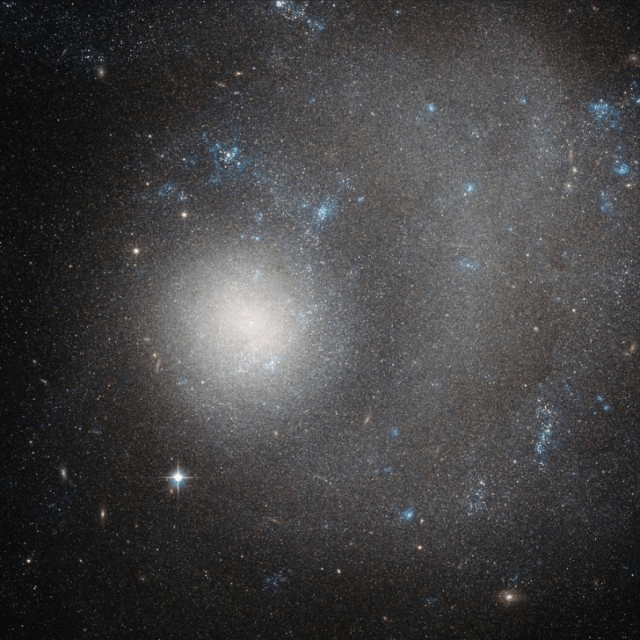
The galaxy is often classified as a dwarf spiral galaxy because it shows signs of a spiral structure. Due to tidal interactions with M101, the galaxy’s disk is offset from the nucleus, and so is the star formation. NGC 5474 is the closest companion to M101. It has a visual magnitude of 11.3 and is 22 million light-years from the Solar System.
 Khanh's Gallery
Leave a comment