It is a fundamental tenet of general knowledge that the Moon orbits the Earth, while the Earth and other planets orbit the Sun. However, from the rigorous standpoint of physics and orbital mechanics, are these simplified models entirely accurate?
The Mechanics of Orbital Motion
The orbital motion of celestial bodies—whether satellites orbiting planets or planets orbiting stars—is primarily governed by the mutual gravitational interaction between the bodies. As defined by Newton’s Law of Universal Gravitation, the attractive force is directly proportional to the product of the masses of the two interacting bodies.
In a system where one body possesses significantly greater mass than the other (e.g., the Sun relative to the planets) and the separation distance is sufficiently small, the gravitational force accelerates the smaller body toward the larger one. However, strictly speaking, the smaller body is not merely “falling” into the larger one; it possesses a tangential velocity (velocity perpendicular to the gravitational pull). If this tangential velocity is sufficient to create a centrifugal effect that balances the gravitational force, the object enters a stable, continuous orbit. (This principle has been utilized for over half a century to launch artificial satellites, achieved by imparting sufficient tangential velocity at orbital insertion).
The Two-Body Problem: No Object Strictly Orbits Another
It is crucial to recognize that according to Newton’s Third Law, gravitational force is reciprocal. The two bodies exert an equal and opposite force upon each other; the massive body pulls the smaller one, but the smaller one also pulls the massive one. This holds true for all systems, including the Sun-Planet interactions. Consequently, physically speaking, no planet orbits purely around the geometric center of the Sun.
When analyzing planetary motion, we must consider the Sun-Planet system as a two-body system (temporarily neglecting perturbations from other celestial bodies). The center of mass of this system is located at the common barycenter. Both bodies orbit this specific point in space; neither orbits the geometric center of the other.
For two bodies, arbitrarily designated as 1 and 2, the position of the barycenter relative to the center of each body is determined by the following equations:
Where
- and : The distances from the centers of body 1 and body 2, respectively, to the barycenter.
- and : The masses of body 1 and body 2.
- : The semi-major axis (or the distance between the centers of the two bodies).
Analysis of Mass Ratios
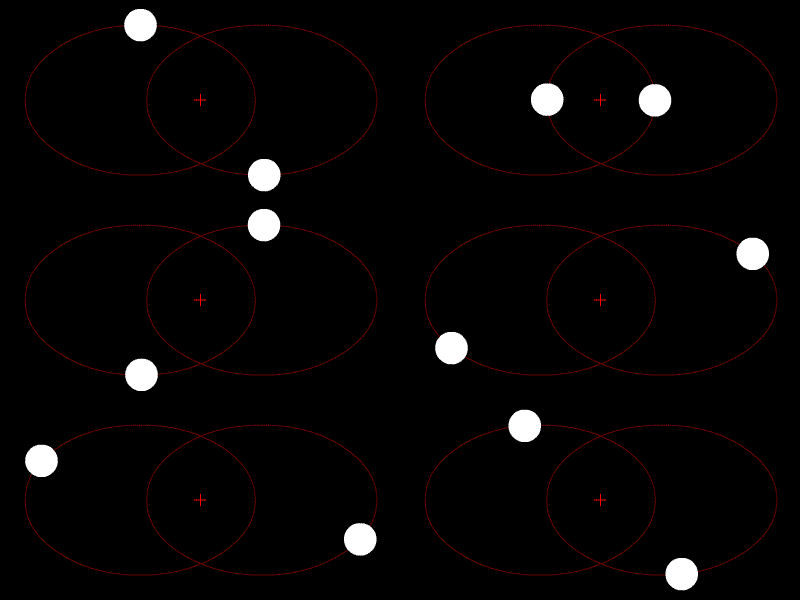
From the equations above, if , then . In this scenario, the barycenter lies approximately at the midpoint of the line connecting the two bodies. Both objects orbit a point in empty space between them. This is commonly observed in binary star systems within our galaxy.
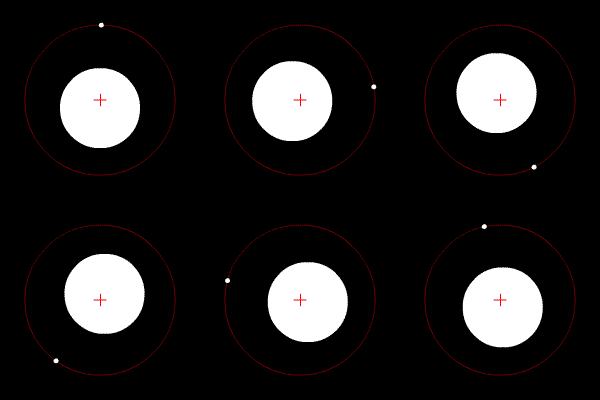
Conversely, as the ratio of to increases (where is the massive body), decreases significantly relative to . The barycenter shifts toward the more massive body. If the mass differential is extreme, the barycenter may reside deep within the interior of the massive body, closely approaching its geometric center. This is the typical configuration for star-planet systems.
Case Study: The Earth-Sun System
Let us apply this to the Earth-Sun system, designating the Sun as body 1 and Earth as body 2.
If we normalize Earth’s mass () to 1 unit, the Sun’s mass () is approximately 333,000 units. The average distance () is approximately 150 million km (1 Astronomical Unit).
This result represents the distance from the Sun’s geometric center to the system’s barycenter. Given that the solar radius is approximately 695,700 km, the barycenter is located deeply within the Sun’s core (the solar radius is over 1,500 times larger than ). Consequently, the barycenter is nearly coincident with the Sun’s center, creating the apparent motion that Earth orbits the Sun’s center. However, physically, both bodies orbit this internal point.
Case Study: The Jupiter-Sun System
The location of the barycenter varies for each planet due to differences in mass and orbital distance. The most distinct case in our Solar System is Jupiter, the most massive planet.
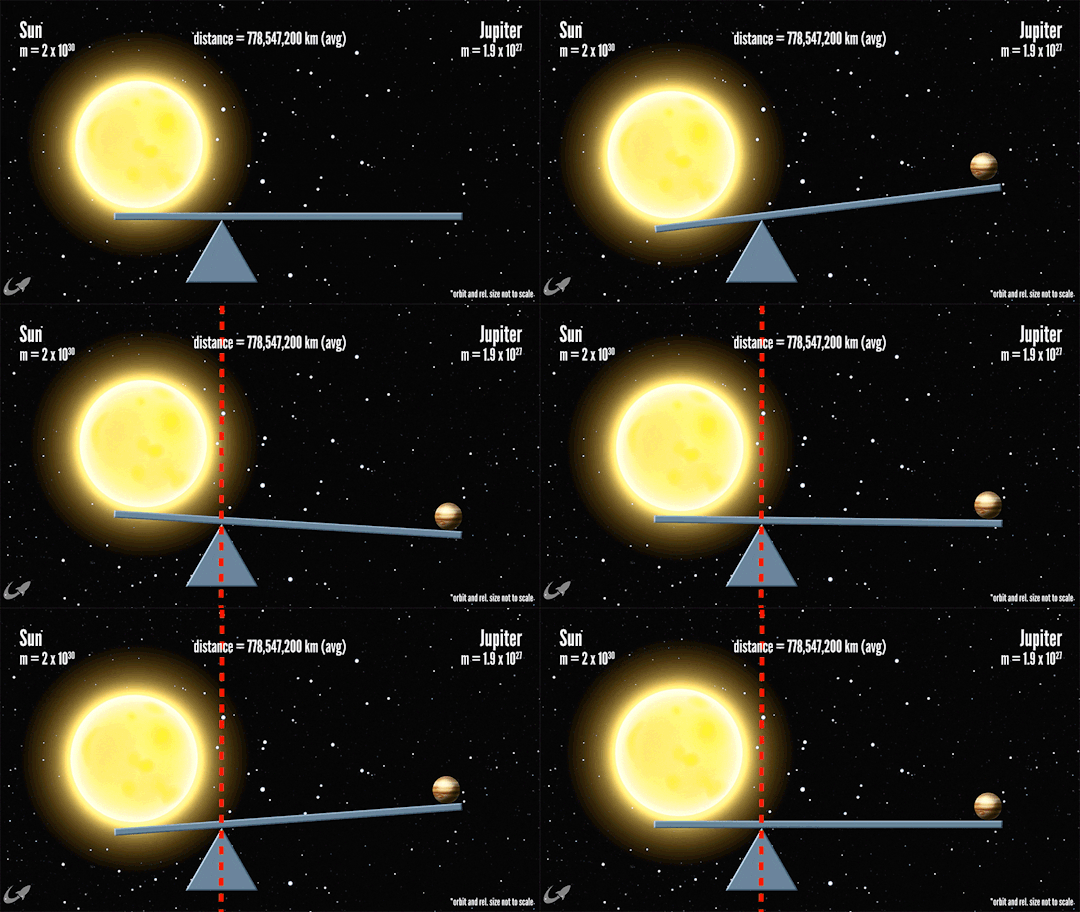
Using the same convention: Jupiter’s mass () is 318 Earth masses, and the distance () is 778 million km (5.2 AU).
In this scenario, the barycenter is located significantly further from the Sun’s center than in the Earth’s case. Since 742,000 km exceeds the solar radius (695,700 km), the barycenter of the Jupiter-Sun system lies outside the solar surface (above the photosphere).
Conclusion: The Definition of Orbit
Since the Jupiter-Sun barycenter lies outside the Sun, implies Jupiter is the only planet that does not orbit inside the Sun?
Does this mean Jupiter is the only planet that does not orbit the Sun?
The answer is NO.
Every gravitationally bound pair, as analyzed above, orbits a common barycenter. No object orbits strictly around the geometric center of another. In every binary system, the bodies effectively orbit “each other.”
When we use the colloquial phrasing “Earth orbits the Sun,” we are describing a relative motion or an apparent reference frame. This phrasing is universally accepted for all planets, dwarf planets, asteroids, and comets, all of which orbit the common barycenter they share with the Sun. However, if we adhere to the strict precision of physics to determine if any celestial body orbits the exact geometric center of the Sun, the answer is unequivocally that no such body exists.
 Khanh's Gallery
Leave a comment