
Lyra is a constellation located in the northern celestial hemisphere. Its name is derived from the lyre, a famous string instrument popular in Ancient Greece and subsequent periods. This constellation is associated with the myth of the renowned Greek musician and poet, Orpheus. It was first cataloged by the Greek astronomer Ptolemy in the 2nd century.
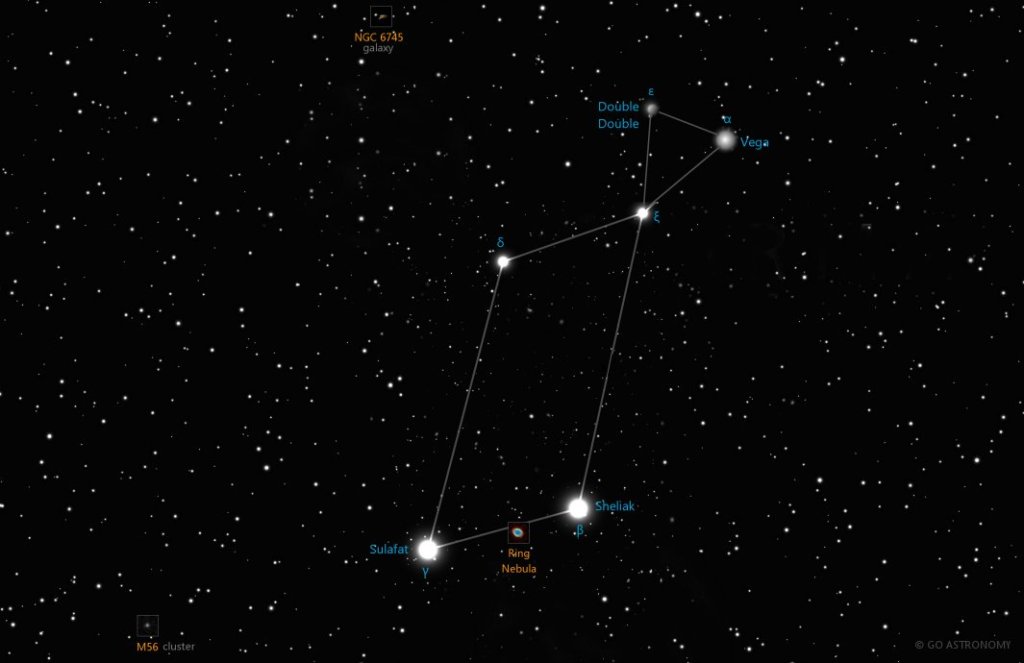
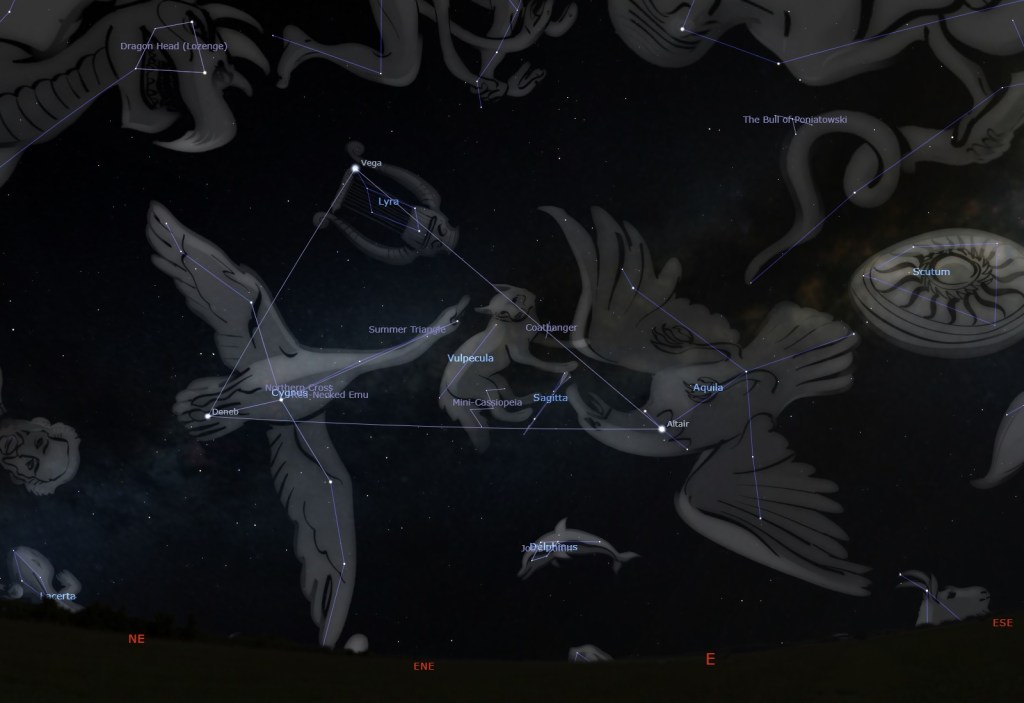
Lyra contains a very famous star, Vega, which is the 5th brightest star in the night sky and the 2nd brightest in the Northern celestial hemisphere. Together with two other stars, Deneb (in Cygnus) and Altair (in Aquila), it forms a prominent asterism known as the Summer Triangle.
Additionally, Lyra hosts several deep-sky objects such as the globular cluster M56, the Ring Nebula (M57), the open cluster NGC 6791, the merging galaxy triplet NGC 6745, and notably, a very famous variable star, RR Lyrae.
Facts and Location
Lyra is a small constellation, ranking 52nd in size in the night sky, covering an area of approximately 286 square degrees. It is located in the fourth quadrant of the northern hemisphere (NQ4) and is visible at latitudes between +90° and -45°. Neighboring constellations include Cygnus, Draco, Hercules, and Vulpecula.
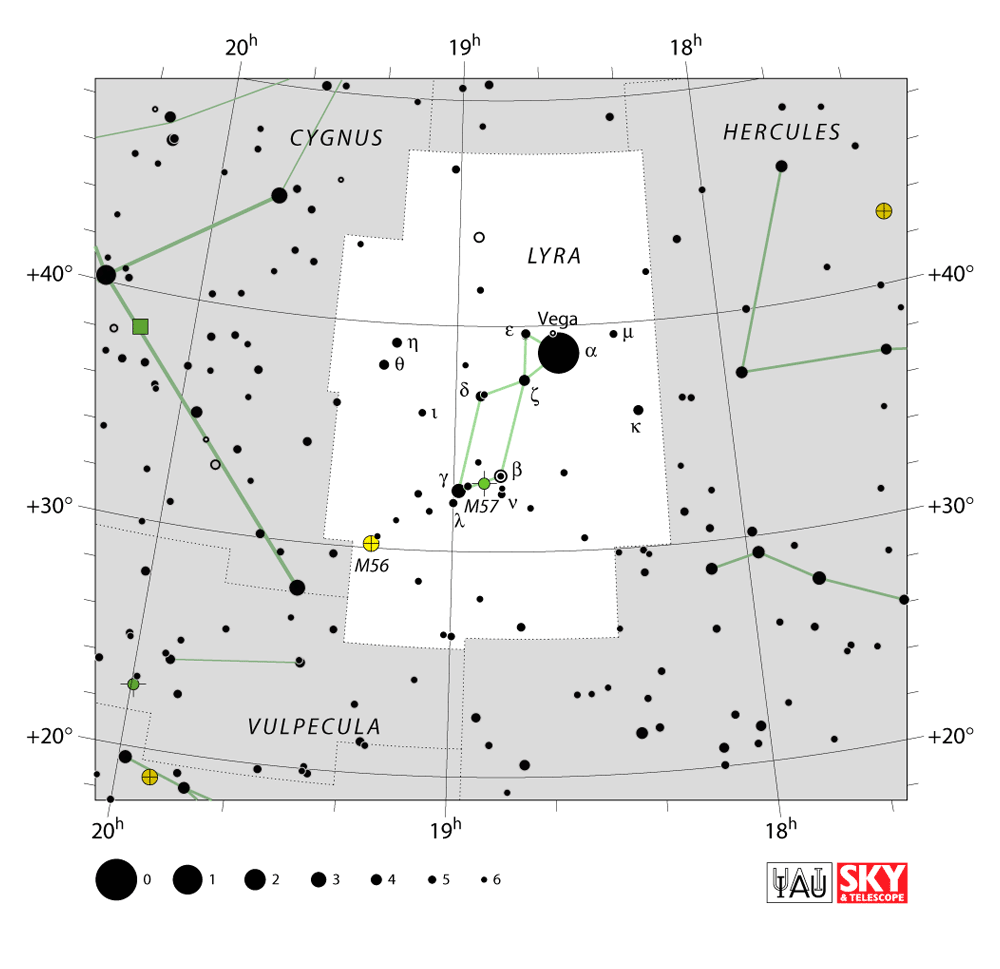
The constellation’s Latin name is Lyra (pronounced /ˈlaɪrə/). Its genitive form, used for naming stars within the constellation, is Lyrae (pronounced /ˈlaɪriː/). The three-letter abbreviation “Lyr” was adopted by the International Astronomical ULnion (IAU) in 1922.
Lyra belongs to the “Hercules Family” of constellations, along with Ara, Centaurus, Corona Australis, Corvus, Crater, Crux, Cygnus, Hercules, Hydra, Lupus, Aquila, Ophiuchus, Sagitta, Scutum, Serpens, Sextans, Triangulum Australe, and Vulpecula.
Vega (Alpha Lyrae) is the brightest star in Lyra, with an apparent magnitude of 0.03. Furthermore, there are five other stars with names officially approved by the IAU, including: Aladfar (Eta Lyrae), Sheliak (Beta Lyrae), Sulafat (Gamma Lyrae), Xihe, and Chasoň. This constellation is also the radiant point of the famous Lyrids meteor shower, which usually peaks around April 20–21 annually. Additionally, there are two minor showers: the June Lyrids and the Alpha Lyrids.
Mythology
The constellation Lyra represents the lyre of Orpheus, a famous musician and poet in Greek mythology. Upon his death, he threw his lyre into the river; subsequently, Zeus sent an eagle (represented by the constellation Aquila) to retrieve Orpheus and his lyre and place them in the sky.
Orpheus was the son of Oeagrus, King of Thrace (a region in Southeast Europe comprising parts of modern-day Bulgaria, Greece, and Turkey), and the muse Calliope. In his youth, he was gifted a golden lyre by the Sun God, Apollo, who taught him how to play it. His mother taught him how to compose verses.
Orpheus was famous for his ability to enchant everyone and everything with his music, even inanimate stones. He was a companion of Jason and the Argonauts (a group of heroes in Greek mythology) on their quest for the “Golden Fleece.” Orpheus used his magical music to save the Argonauts from the voices of the Sirens (whose enchanting songs would disorient sailors, causing them to crash their ships into the rocky shores where the Sirens lived). When the Argonauts approached the island, Orpheus played his lyre, drowning out the Sirens’ calls.
The most famous story about Orpheus concerns his tragic romance with the nymph Eurydice. They fell in love, married, and lived happily for a short time. However, this happiness did not last long. While walking in the forest with other nymphs, she was spotted by Aristaeus, a hunter who became infatuated with her. He wanted to possess her for himself. She refused and fled, but unfortunately slipped and fell into a nest of snakes; a bite to her heel sent her to the afterlife.
Orpheus found her and wept; his music moved everything from tiny creatures to the gods on Mount Olympus. The gods advised him to travel to the Underworld and try to bring Eurydice back. upon reaching the Underworld, Orpheus persuaded Hades, the ruler of the dead, to return his wife. However, there was one condition: during the entire journey back, neither was allowed to look back until they reached the world of the living.
Unfortunately, Orpheus forgot that he could only turn around once both had arrived. The moment he stepped onto the surface, he turned back, but Eurydice had not yet touched the living world. She instantly vanished right before his eyes. He tried to return to the Underworld to save his wife but was refused by the ferryman.
Devastated, Orpheus grew to detest everything after losing Eurydice. Eventually, he was killed by the Maenads (frenzied, drunken female worshippers of the wine god) for failing to honor the god Dionysus during his festival. After Orpheus’s death, the Muses took his lyre to the heavens and cremated his body at the foot of Mount Olympus.
The constellation Lyra is often depicted as a vulture or an eagle carrying Orpheus’s lyre and was historically referred to as Aquila Cadens or Vultur Cadens, meaning “Falling Eagle” or “Falling Vulture.”
Additionally, in Wales, this constellation is known as “King Arthur’s Harp” or “King David’s Harp.”
 Khanh's Gallery
Leave a comment