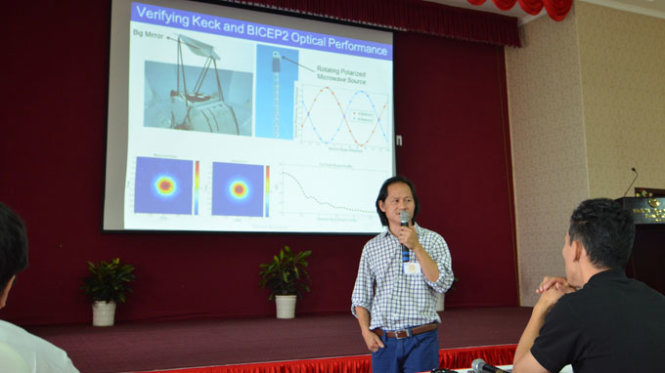
Although living and working abroad, he continues to make significant contributions to the development of domestic science.
The First Person to Plant the Vietnamese Flag in Antarctica
Dr. Nguyen Trong Hien was born in 1963 in Da Nang. After graduating from high school in 1981, he immigrated to the United States at the age of 18. There, he studied Physics at the University of California, Berkeley. Upon graduation, he continued his studies and received his Ph.D. from Princeton University in 1993, specializing in Cosmic Microwave Background (CMB) radiation research.
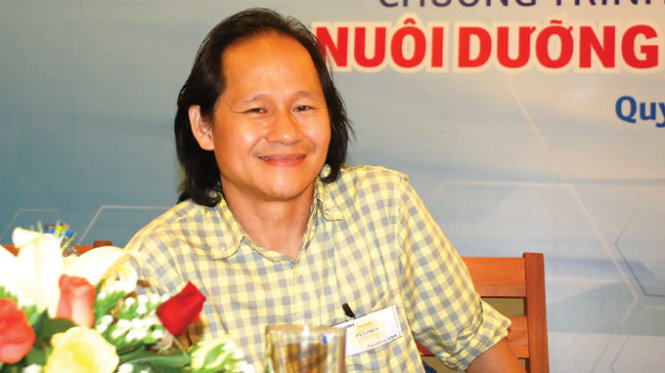
After completing his doctoral program, he moved to Chicago to pursue post-doctoral research in Astrophysics at the University of Chicago. Subsequently, Dr. Nguyen Trong Hien served as a Special Lecturer at Carnegie Mellon University before joining NASA’s Jet Propulsion Laboratory (JPL).
In his role as a Senior Research Scientist specializing in astrophysics at NASA, Dr. Hien has made important contributions to the astrophysics division at JPL. Simultaneously, he continued his post-doctoral research work at the University of Chicago.
In 1992, Dr. Nguyen Trong Hien began participating in scientific research projects in Antarctica, focusing on Cosmic Microwave Background radiation. Witnessing the flags of major world powers flying in the Antarctic sky, he cherished the aspiration to bring the Vietnamese flag to this remote land.
In 1994, he returned to Antarctica for a second time and stayed for nearly a year. In July of that year, Comet Shoemaker-Levy 9 collided with Jupiter. From July 16 onwards, giant plumes of fire erupted, reaching thousands of kilometers in height. Massive fragments of the comet, comparable in size to mountains, slammed into Jupiter’s surface, creating impact scars with diameters as large as the Earth.
Dr. Nguyen Trong Hien witnessed this rare event—which occurs only once in millions of years—from beginning to end. At that time, he was the Science Leader at the Amundsen-Scott South Pole Station, where 27 American scientists and technicians were working.
Moreover, in September 1994, Dr. Hien personally hand-sewed a 4-square-meter red flag with a yellow star and planted the Vietnamese national flag amidst the Antarctic ice at the Ceremonial South Pole, alongside the flags of the US, Russia, UK, Germany, France, Japan, Australia, New Zealand, Chile, Argentina, and South Africa.
Additionally, Dr. Nguyen Trong Hien is the only Vietnamese-American scientist to participate in the launch program of the two largest space observatories in history by the European Space Agency (ESA) in collaboration with NASA: Planck and Herschel.
Deeply Devoted to the Motherland
Despite living and working in the US, Dr. Nguyen Trong Hien always looks toward his homeland, Vietnam. In 2010, he was invited back to teach in the Advanced Physics program at Hue University of Education. Since then, every year, despite his busy schedule, he dedicates several weeks to teaching in Hue and Quy Nhon.
Not only contributing to education, Dr. Hien also enthusiastically collaborates with domestic astronomers, helping to establish a modern telescope in Vietnam. In 2022, he announced the establishment of the SAGI Astrophysics Group at the ICISE Center (International Centre for Interdisciplinary Science and Education), with funding from the Simons Foundation (USA). The launch event was attended by leaders and representatives from the Ministry of Science and Technology, the Binh Dinh Provincial People’s Committee, the “Rencontres du Vietnam” (Meet Vietnam) Association, and many international organizations such as the Flatiron Institute (USA), the Institut d’Astrophysique de Paris (IAP – France), RIKEN Research Institute (Japan), and nearly 100 domestic and international scientists. Additionally, excellent students from specialized schools in Binh Dinh also participated in this event.
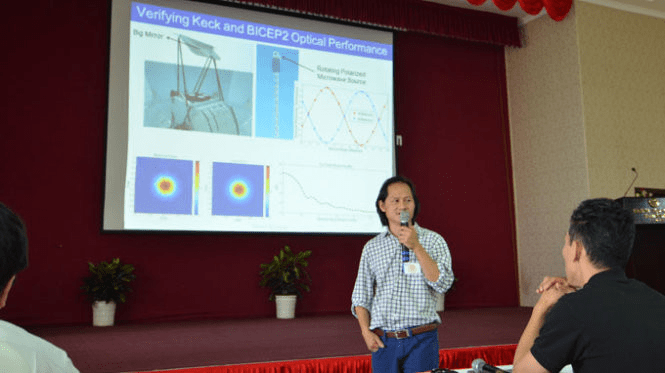
Prior to this, in 2016, Dr. Hien and several Vietnamese scientists working abroad organized an Astrophysics conference at the ICISE Center. The conference received enthusiastic support from scientists and international scientific organizations in the region, such as those from Japan, South Korea, and Taiwan.
From the success of that conference, Dr. Nguyen Trong Hien and his associates nurtured the idea of establishing an Astrophysics group in Vietnam. Thanks to the prestige of Professor Tran Thanh Van and Professor Le Kim Ngoc, along with Dr. Hien’s dedication, they successfully secured funding from the Simons Foundation to establish the SAGI Astrophysics Group.
 Khanh's Gallery
Leave a comment