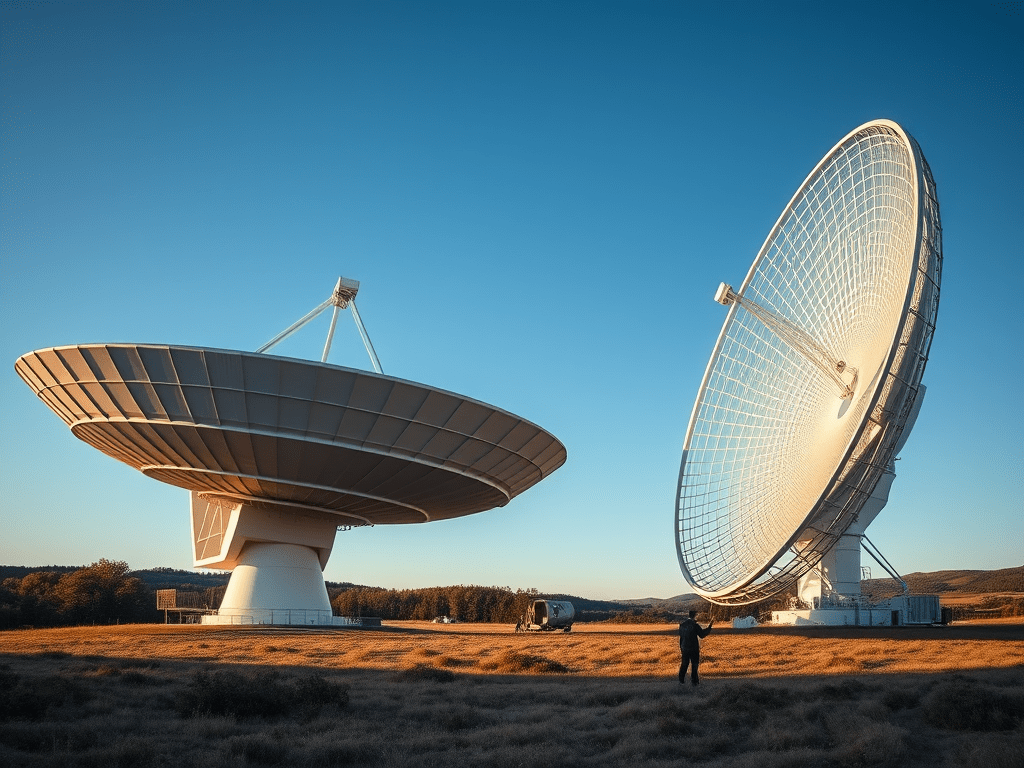
The revitalization of Vietnam’s education and science is essential and has been widely discussed within the community of scientists both at home and abroad.
A Fundamental, Experimental, and Applied Science
Thanks to the mechanical laws of Newton and Kepler, scientists can calculate orbits to launch satellites serving the telecommunications industry, such as television broadcasting and mobile phone systems. The Global Positioning System (GPS), used to determine the location of ships at sea, aircraft in the sky, and to guide drivers navigating through city streets, can only achieve very high precision if Einstein’s theory of relativity is applied. Modern techniques for manufacturing telescopes are used in medicine to diagnose diseases in the retina at the back of the eye. Astronomy also answers, to some extent, the metaphysical and philosophical questions that humanity has cherished since ancient times. Observing the sky is to understand the origins of the universe and humanity, and to detect other civilized worlds, if they exist, on distant planets outside the solar system.
The primary goal of astronomy remains the study of celestial phenomena, the life and death of stars and galaxies, and the evolution of the entire universe. Determining physical-chemical conditions in the “natural laboratory” of the universe is also an equally important topic in astrophysics. Because radiation from distant galaxies collected by telescopes and antennas is very weak, astronomers must use massive optical and radio telescopes along with cutting-edge electronic equipment to detect individual photons. They also launch satellites into space to avoid atmospheric turbulence, which blurs the images of celestial bodies. The techniques for building telescopes that are both large and lightweight, and creating electronic signal receivers of increasing sensitivity, have contributed to the development of advanced technology.
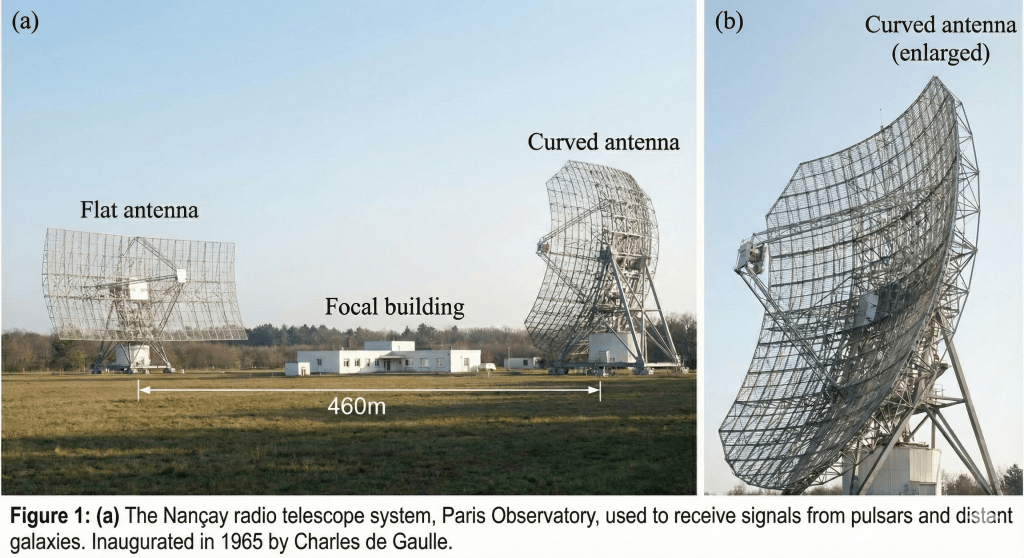
(a) The radio telescope system located at Nançay, in the Sologne countryside (180 km south of Paris), features two giant antennas positioned 460 meters apart. On the left side of the image is the flat antenna (measuring 200 m x 40 m), which rotates around a horizontal axis and reflects cosmic radio signals onto the curved antenna (on the right side of the image, measuring 300 m x 35 m). The signals are focused onto the focal point (the low white building between the two antennas), where a spectrometer receives and analyzes the signals.
(b) An enlarged image of the curved antenna shown on the right side of figure (a).
The Nançay system, part of the Paris Observatory, is used to receive radio signals emitted from pulsars—the cores of exploded stars—as well as distant galaxies. The Nançay Radio Telescope was inaugurated by French President Charles de Gaulle in the spring of 1965 (Image courtesy of Nançay Radio Astronomy Center).
After World War II ended, engineers who had previously performed military service in air defense and detecting warships via radar became pioneer scientists building antennas and electronic devices to receive radio signals from the universe. Radio astronomy was developed precisely thanks to the efforts of these radar technical experts. Many important astronomical discoveries, such as the detection of Cosmic Microwave Background (CMB) radiation—essential evidence reinforcing the Big Bang theory—were made at radio wavelengths. The symbiosis between basic science and engineering is a necessary element in the development process of modern astronomy.
Astronomers use the latest physical theories along with results obtained from telescopes to understand the origin and evolution of the universe. Massive observational projects and theoretical models running continuously for months on supercomputers have helped astronomers simulate the structure of the entire universe.
Solutions for Developing Astrophysics in Vietnam
The universe is an environment containing all the physical-chemical phenomena we need to observe and study in order to replicate them in laboratories on Earth. Astronomers found organic matter HC11N (a type of cyanopolyyne—a chemical with long chains of carbon linked together) in the Milky Way. When chemists wanted to understand the formation mechanism of cyanopolyyne in the laboratory, they accidentally created Fullerenes, which have a structure like a microscopic soccer ball composed entirely of carbon atoms. Fullerenes are highly durable and are used in nanotechnology. Understanding the mechanism of energy generation within the Sun and stars also helps physicists achieve thermonuclear reactions (fusion), which release far more energy than fission reactions in atomic reactors.
Vietnam does not necessarily need to build expensive observatories and large telescopes to observe the universe immediately. Global astronomers form a community without borders. In the initial period without equipment, Vietnamese astronomers can collaborate with foreign colleagues and utilize existing telescopes around the world. They do not need to visit the observatory in person but can monitor observations remotely via computers and process data in domestic laboratories. They can also use computers to create theoretical models to explain the results obtained.

The essential thing is to train enough experts, even if it means sending them abroad, so that upon their return, they can establish a leading team in astronomy. Previously, astrophysics in Spain was hardly significant. However, in just three decades, after sending students to study in neighboring countries with astronomical traditions like France and Germany, Spain now possesses a very dynamic and prestigious team of young radio astronomers.
The toolkit of astrophysicists is very diverse, allowing them to operate in many different scientific fields. With the support of the International Astronomical Union (IAU), many astrophysics courses have been organized in Vietnam. From 1996 to 2005, Vietnamese students were awarded scholarships to intern and conduct doctoral research in astrophysics at Paris 6 University and the Paris Observatory. They have returned to work in the country, including those who successfully defended their doctoral theses in Paris. However, they are not concentrated in a single agency to collaborate, nor are they numerous enough to establish a specialized astronomy research department.
The Phu Lien Observatory in Kien An, Hai Phong, was built by the French administration at the beginning of the last century, mainly for weather forecasting and solar observation. Professor Nguyen Xien was the first Vietnamese scientist appointed as Director of Phu Lien Observatory. During wartime, the telescope and optical equipment were moved elsewhere. Currently, the main task of Phu Lien Station is meteorological monitoring.
The humid tropical climate in Vietnam presents challenges for observing the sky in the optical spectrum and at short millimeter radio wavelengths. Most contemporary radio telescopes globally function at millimeter wavelengths; however, radio waves at longer wavelengths of 10 cm or more can penetrate the atmosphere even during rainfall without being significantly absorbed by the moisture-laden air. Consequently, it remains feasible to advance radio astronomy in Vietnam. Tropical nations such as India have established radio interferometric systems that operate at extended wavelengths to detect radiation from ubiquitous hydrogen atoms within the universe. Due to the expansion of the universe, the hydrogen line emitted at the 21 cm wavelength from distant galaxies experiences a shift toward longer wavelengths (redshift). These observational findings significantly contribute to astronomers’ comprehension of the primordial universe. Furthermore, India serves as a destination where Vietnamese students can pursue internships in the field of radio astronomy.
The late Professor Hoang Xuan Han was someone deeply concerned with the country’s astronomy. He was a profound scholar, not only in science and calendar making but also in cultural issues.
In the framework of scientific cooperation between Vietnam National University, Hanoi and the Universities of Paris VI (Pierre and Marie Curie), and the Paris Observatory, in early November 2010, a Workshop on Space Science and Climatology in Vietnam was organized on the occasion of the Millennial Anniversary of Thang Long–Hanoi. Leading French scientists presented the latest results obtained by ground-based and space telescopes, along with the potential for developing astronomy in Vietnam. Scientists assessed that industrial emissions are causing global warming, potentially turning Earth into a barren planet. Space exploration techniques are also used to predict climate trends.
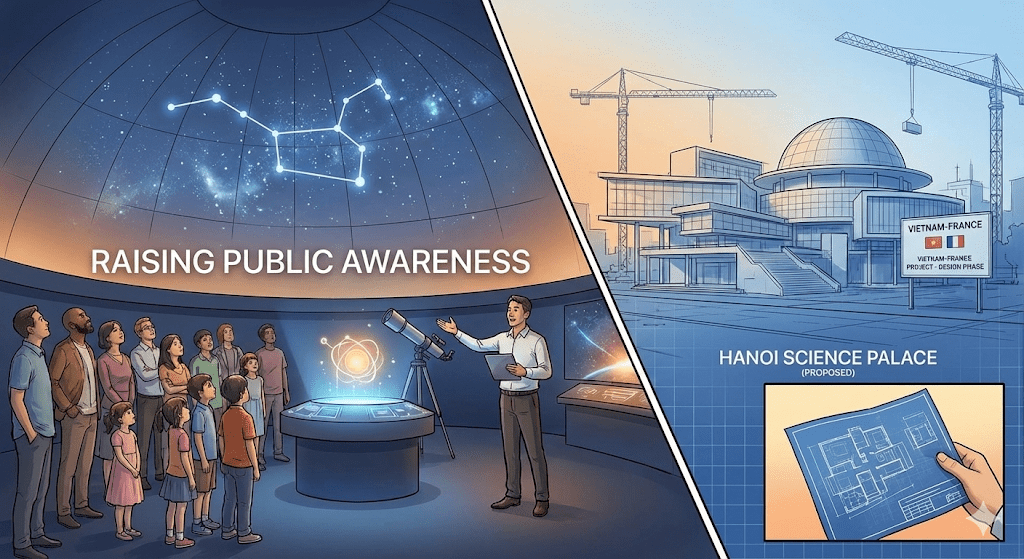
Simple scientific experiments and astronomical shows under the dome of a planetarium are measures to raise public awareness and intellectual standards. There has been a Vietnam-France project to build a Science Palace in the capital, Hanoi, which includes a planetarium, to popularize science for the general public. However, to date, the construction of the Science Palace still remains in the design phase.
The brilliant success of Vietnamese mathematics is a driving force promoting the development of other sciences, including astrophysics.
 Khanh's Gallery
Leave a comment