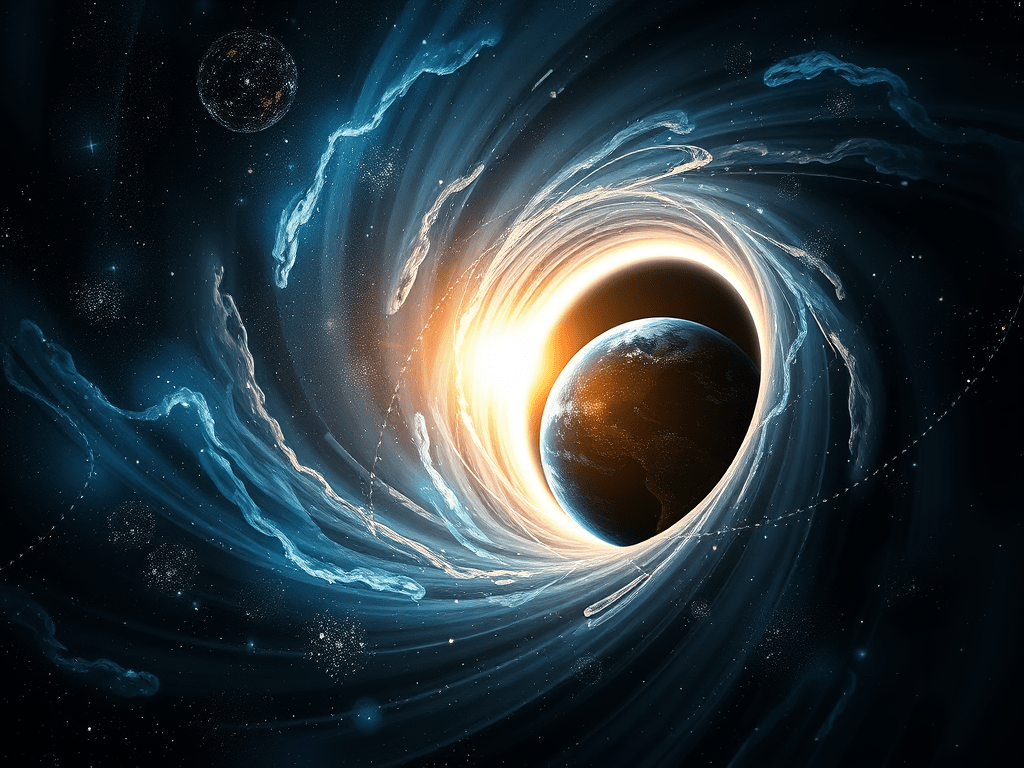
Is there a possibility that Earth will eventually be consumed by a black hole? The answer is relatively straightforward, yet it elucidates one of the most fundamental—and often misunderstood—principles of nature.
Black Holes: Defining the Phenomenon
A black hole is a region where spacetime curves to an infinite degree, preventing any matter or radiation from escaping. These objects are typically the end-state of a massive star‘s evolution. When such a star depletes the hydrogen fuel necessary for thermonuclear fusion—the process generating the outward pressure that counteracts gravitational collapse—it implodes. This most common class is designated as a stellar-mass black hole.
Conversely, observational data confirms that the centers of most galaxies, including our own Milky Way, host supermassive black holes (SMBHs), possessing masses millions or billions of times that of the Sun. Astronomers also hypothesize the existence of intermediate-mass black holes (IMBHs), bridging the gap between stellar and supermassive variants, though definitive detection remains elusive.
Regardless of mass, all black holes possess a boundary known as the Event Horizon. At the geometric center lies the Singularity—a point where the black hole’s mass is concentrated. Theoretically, once the event horizon is breached, the escape velocity exceeds the speed of light (), rendering escape impossible, even for photons.
This leads to a prevalent anxiety: If light cannot escape, does a black hole possess the capacity to indiscriminately consume the universe, including Earth, if one were nearby?
The Myth of Infinite Gravitational Force
A widespread and fundamentally erroneous deduction—perpetuated by sensationalist media and inaccurate literature—is that the gravitational force exerted by a black hole is infinite.
In physics, no force is truly infinite. Conceptually, an infinite force would imply an instantaneous interaction across all space and time. If a black hole possessed infinite gravity, it would consume the entire universe at the moment of its formation. Consequently, the universe would have collapsed immediately after its genesis, precluding the formation of stars or planets.
What, then, is Infinite?
The term “infinite” found in standard physics literature regarding black holes refers to the infinite curvature of spacetime at the singularity.
Mathematically, in Einstein’s General Theory of Relativity, spatial curvature is described by tensors. If specific parameters within these tensors approach infinity, a singularity manifests. To visualize this without complex equations: consider an ideal plane or line as having zero curvature. As you bend it, curvature increases. Infinite curvature occurs when a plane is compressed into a dimensionless point. This corresponds to the formation of a singularity when a massive stellar core undergoes gravitational collapse.
This infinite curvature creates a spacetime region where all geodesics (paths) lead inward. The boundary of this “point of no return” is the Event Horizon. Thus, the “infinity” refers to geometry, not the gravitational pull exerted on distant objects.
Revisiting Gravitational Mechanics
Newton’s Law of Universal Gravitation (17th century) states that the force between two bodies is directly proportional to the product of their masses and inversely proportional to the square of the distance between them (). This law remains valid for general orbital mechanics.
Black holes are no exception. Outside the event horizon, a black hole behaves like any other massive object. In binary systems, when a star collapses into a black hole, the companion star often continues its orbit (albeit modified by mass loss). While mass transfer (accretion) can occur if proximity is extreme, stable orbits persist if the separation is sufficient.
Hypothetically, if the Sun were replaced by a black hole of 4 solar masses (), the gravitational force on Earth would increase fourfold. To maintain the current gravitational force, Earth’s orbit would need to be doubled in radius. If we replaced the Sun with Sagittarius A* (the Milky Way’s central black hole, ), Earth would need to be moved to a distance 2,000 times greater than its current orbit to maintain gravitational equilibrium.
The Probability of a Black Hole Encounter
Given that gravity is not infinite, the fear of a rogue black hole destroying Earth is unfounded.
As of 2023, the nearest known black hole is in the system Gaia BH1 (constellation Ophiuchus), approximately 10 solar masses and located 1,560 light-years away. At this distance, its gravitational perturbation on the Solar System is negligible.
Astrometric measurements indicate Gaia BH1 is receding from us at roughly 23 km/s. Even in a worst-case hypothetical scenario where a similar system approaches us at the Solar System’s galactic orbital velocity ( km/s), it would take roughly 2 million years to arrive. Given the vastness of the interstellar medium, the probability of a stellar collision is statistically infinitesimal—far lower than hitting a specific bee from kilometers away while blindfolded.
Micro Black Holes on Earth?
Concerns have been raised regarding experiments at the Large Hadron Collider (LHC) at CERN potentially creating black holes. These fears are often fueled by science fiction misunderstandings of particle physics.
In 1916, Karl Schwarzschild solved Einstein’s field equations to determine the critical radius at which a mass collapses into a black hole. This is the Schwarzschild radius ():
- : Gravitational constant ()
- : Mass of the object
- : Speed of light ()
If Mount Everest (kg) were compressed into a black hole, its Schwarzschild radius would be roughly meters—subatomic scale. Applying Newton’s law, the gravitational pull of this “Everest black hole” on a 100kg person standing 100 meters away would be a mere N.
At the LHC, particle collisions might theoretically form microscopic singularities. However, these would be so minute that they could not accrete matter effectively. Furthermore, according to Quantum Field Theory in curved spacetime, they would instantly dissipate via Hawking Radiation.
Conclusion
The scenario of Earth’s annihilation by a black hole is scientifically implausible for the foreseeable future (millions of years). The laws of physics dictate that there is no cause for alarm regarding this cosmic phenomenon.
 Khanh's Gallery
Leave a comment