The names “Bắc Đẩu” and “Nam Tào” have long been familiar in East Asian culture in general, and Vietnamese culture in particular. Many documents and popular speculations suggest that they are stars or constellations in the sky, named centuries ago by Eastern astronomers. Is this true, and what are their actual origins?

Under the Same Sky
One interesting aspect of the history of Astronomy is that it is considered the oldest science stemming from the fact that all humanity shares a single sky.
Although modern astronomers can tell you that stars in the galaxy are not fixed but orbit the galactic center—much like Earth and the planets orbit the Sun—this shift is so slow that the sky has remained virtually unchanged throughout the few thousand years of human civilization. Furthermore, the size of the Earth is minuscule compared to the distance from us to the stars (light travels more than 7 times around the Earth’s equator in just 1 second, yet takes 4 years to reach the nearest star to the Solar System). Therefore, no matter where you stand on the planet, you see the same arrangement and relative spacing between stars. The only thing that differentiates the sky in different geographical regions is latitude. Latitude affects our field of view into the cosmos, so observers at different latitudes may see parts of the sky that do not entirely overlap.
Another interesting point about culture and history is that even with nearly identical viewpoints (seeing the exact same patches of sky), human imagination and cultural characteristics differ by region. If you investigate, you will find that each culture has different conventions and names for constellations.
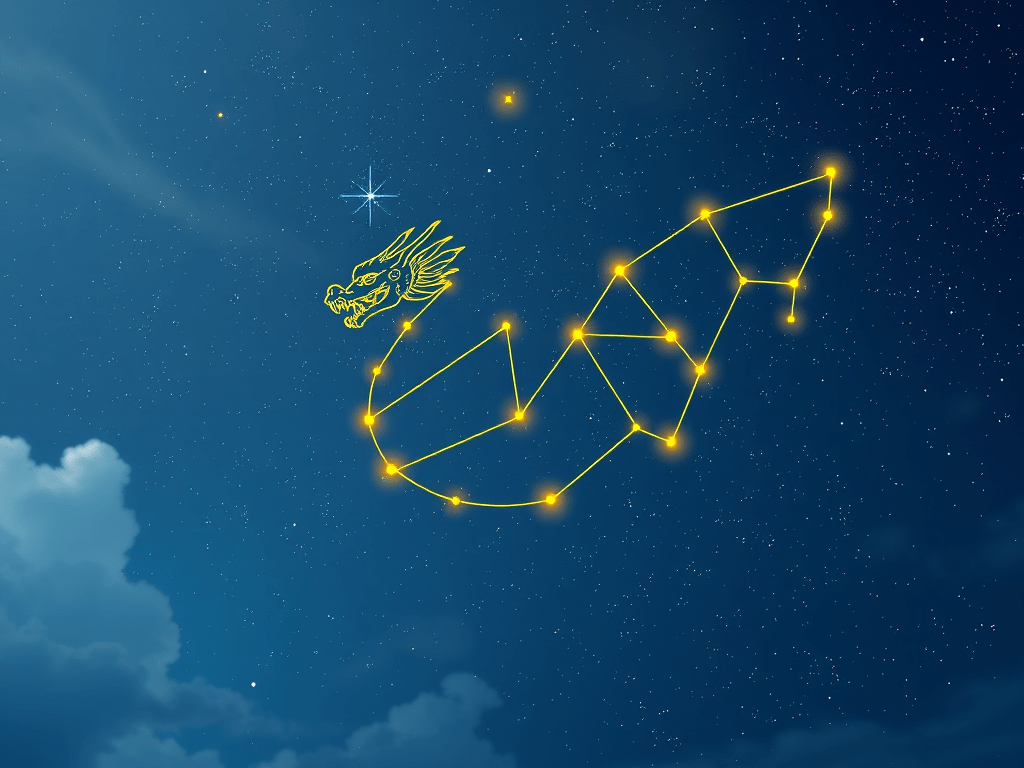
The image above was captured from the Stellarium software, to which the yellow lines were added. These yellow lines, along with the corresponding text, represent 7 constellations (*) out of the Twenty-Eight Mansions (Nhị Thập Bát Tú – 二十八宿) described by Eastern astronomers. This group of 7 constellations is collectively called the “Azure Dragon” (Thanh Long). All 28 mansions consist of stars located along the apparent path of the Moon as it orbits the Earth. Today, modern astronomy has determined that the Moon’s orbit is inclined by only about 5 degrees relative to Earth’s orbit, so this lunar path (called the White Path) nearly coincides with the Ecliptic (the Sun’s apparent path). Thus, as seen in the image, these constellations correspond to the Zodiac constellations known to most of us today.
Same sky, same stars, only the categorization differs!
() In reality, today only the 88 constellations officially designated by the IAU (International Astronomical Union) are accurately termed “constellations.” Conventions not officially listed by the IAU (such as those listed here) are collectively called “asterisms” (star groups). However, for simplicity and accessibility, I will tentatively refer to all of them as “constellations” in this article.
Another point worth noting here is that the understanding of constellations varies between cultures and historical periods.
In the West (the system we use today), constellations were originally groups of stars close to each other that people imagined as the shape of a mythological figure or animal. Later, specifically starting with Claudius Ptolemy in the 2nd century, lines were drawn to connect these stars. In recent centuries, European astronomers established more constellations that Ptolemy and his contemporaries had ignored (because they didn’t care about faint stars) or could not see (stars visible only from the Southern Hemisphere). Finally, by the early 20th century, constellation conventions became clearer: they are specific areas on the sky defined by boundaries (meaning many stars are never connected by lines but belong to a constellation simply because they fall within its area).
In the East, constellations emerged slightly differently. Ancient Chinese astronomers did not rely on the shape formed by connecting stars to name them. Instead, they purely associated each group with an animal or character—usually figures from the Celestial Court according to their legends. They also did not strictly distinguish between a “star” and a “constellation.” For instance, each constellation you see in the image has a main star, called the Principal Star (or Determinative Star – chủ tinh). Example: The Principal Star of the Giac (Horn) constellation is Spica in the constellation Virgo (modern international convention); this star Spica is also referred to as “Sao Giac” (Giac Star). Similarly, the Vi (Tail) constellation has its Principal Star as Antares—the brightest star in Scorpius—and that star is also called “Sao Vi” (Vi Star). In other words, when these names are mentioned, they could refer to the constellation or just the main star; there is no specific boundary.
Understanding this, we move on to identifying what stars or constellations Bac Dau and Nam Tao are.
There is NO “Star” Bac Dau!
Due to translation errors by some individuals many years ago, the vast majority of people who know a few star names or have a slight knowledge of astronomy in Vietnam believe there is a single star named “Bac Dau.” (Many even think it is the brightest star in the sky, or at least in the northern sky).
This is a misconception that needs correction!
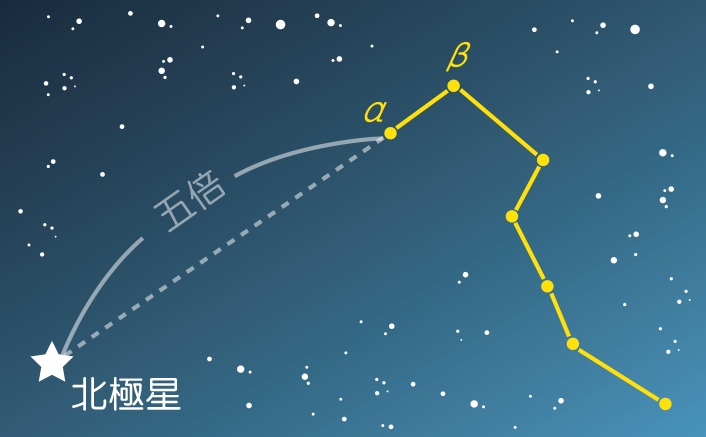
Bac Dau (北斗 – Northern Dipper) is the name of a group of the 7 brightest stars in the constellation Ursa Major (The Great Bear). This star group is easily visible when standing in the Northern Hemisphere and looking north during most of the year (highlighted in yellow in the image). “Bac Dau” means “The Northern Ladle” due to its shape resembling a water ladle. In English, this star group is called the “Big Dipper.”
Thus, Bac Dau is the name of an asterism (or loosely, an ancient Eastern constellation). IT IS NOT A SINGLE STAR.
Which Star/Constellation is Nam Tao?
Answer: There is no Eastern star or constellation named “Nam Tao”!
This is likely a common question because, in mythological works related to China, Bac Dau and Nam Tao always seem to appear as a pair. So, one might wonder if Nam Tao is also a star or constellation like Bac Dau.
First, it must be affirmed that there is nothing called Nam Tao in the sky (according to ancient Chinese conventions). Nam Tao (南曹) is the title of an official position, referring to the deity holding the “Book of Life and Death” in the Celestial Court, assisting the Jade Emperor. However, later on, this figure was often associated with a group of 6 stars in the southern sky called Nam Dau Luc Tinh (南斗六星 – The Southern Dipper Six Stars). Even the name “Nam Dau Luc Tinh” is not the original root; originally, it was just the Dau (Dipper) constellation—one of the 28 constellations on the White Path (Moon’s path) collectively known as the Twenty-Eight Mansions.
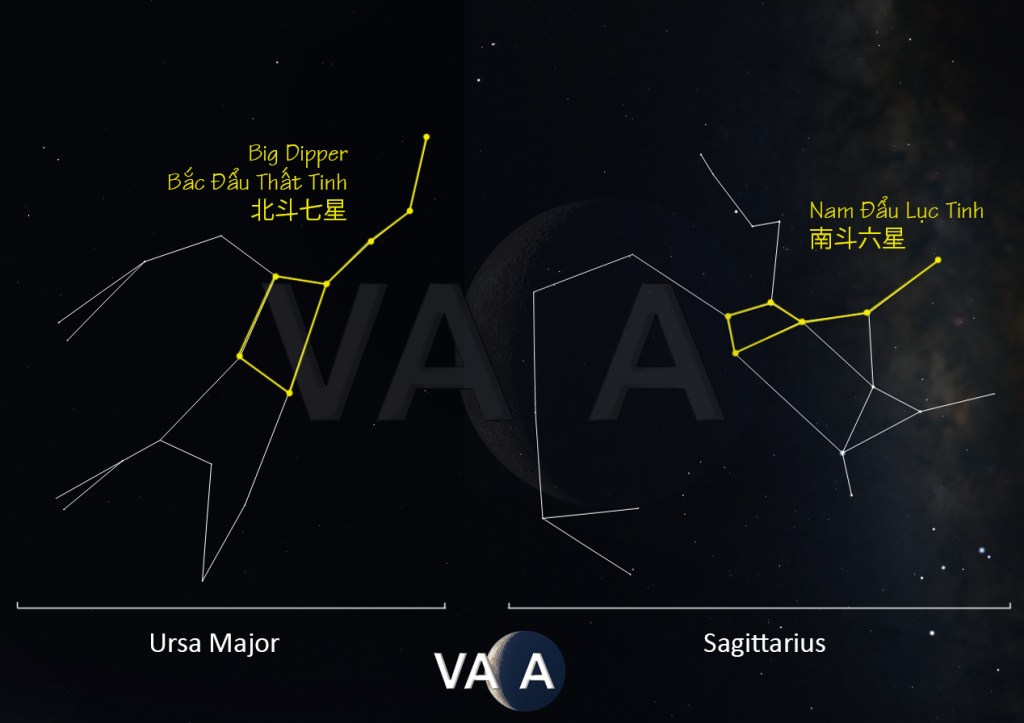
The 6 stars forming “Dau” (斗) are stars that, according to modern international conventions, belong to the constellation Sagittarius (The Archer). They include: Phi Sagittarii (φ Sgr), Lambda Sagittarii (λ Sgr), Mu Sagittarii (μ Sgr), Sigma Sagittarii (σ Sgr), Tau Sagittarii (τ Sgr), and Zeta Sagittarii (ζ Sgr).
As you can see in the image (on the right), this shape is quite similar to the 7 stars forming the Big Dipper (Bac Dau That Tinh). Perhaps that is why it received slightly more attention than most other constellations in the Twenty-Eight Mansions—although literally translated, they are just the “Southern Ladle” and the “Northern Ladle,” not deities as people later attributed.
Therefore, Bac Dau is the name of an ancient Chinese constellation, whereas Nam Tao is not, but is often unofficially attributed to the (Nam) Dau constellation.
In reality, unlike the Big Dipper (Bac Dau), which is prominently recognizable even though it is now considered just a part of Ursa Major, the 6 stars of the Southern Dipper (Nam Dau) are not particularly distinct from neighboring stars in Sagittarius. Usually, you only recognize it… when you already know about it and intentionally look for it within Sagittarius.
Additional Note: In some Vietnamese documents, a few authors deduce that Nam Tao is the name for the constellation Crux (Southern Cross). However, it is easy to see that this is incorrect. Aside from historical issues, there is clear logic here: Crux lies very low in the southern sky, to the point where it is difficult to see completely from Northern Vietnam. For the Chinese astronomers who coined these names and lived at much higher latitudes to the North, they could not see Crux at all to name it.
(According to Dang Vu Tuan Son, http://www.thienvanvietnam.org)
 Khanh's Gallery
Leave a comment