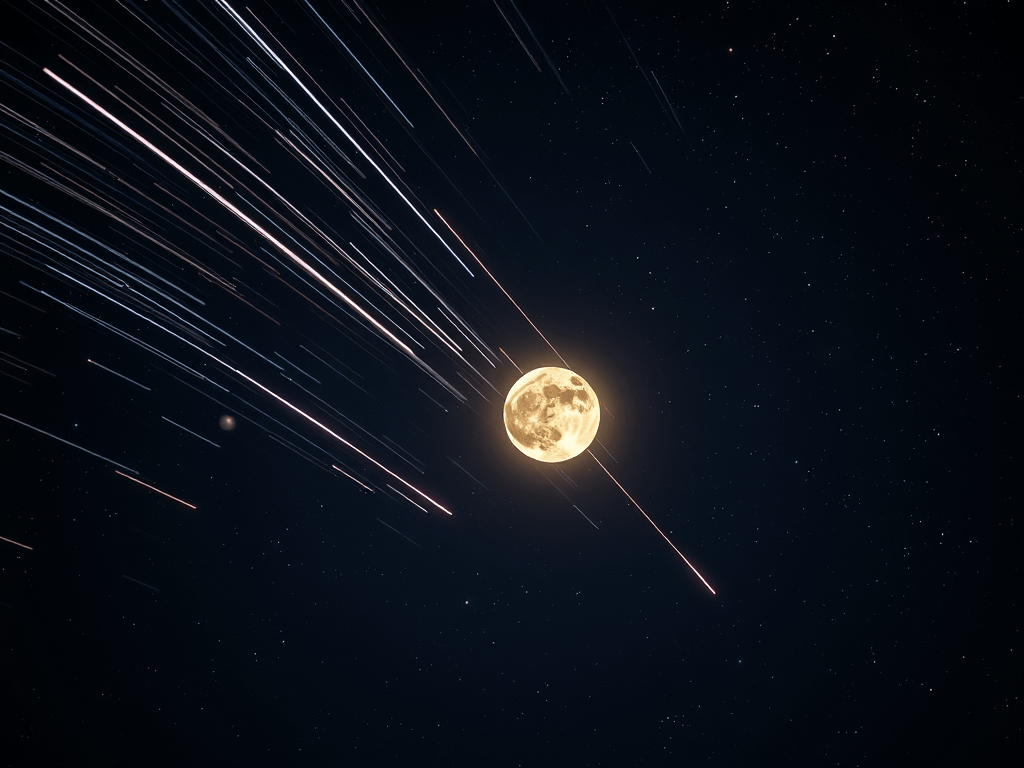
While the celestial events of early 2026 may not present the most conspicuous phenomena compared to other epochs, the period offers a noteworthy convergence of events for the observer: the maximum of the Quadrantids meteor shower, a Supermoon, and Earth’s passage through perihelion occurring on the same day.
The Quadrantids Meteor Shower
The Quadrantids originate from the debris stream of asteroid 2003 EH1—a minor planet orbiting the Sun with a period of approximately 5.5 years. Historically, the shower derived its nomenclature from the constellation Quadrans Muralis. However, following the 1922 formalization of modern constellations by the International Astronomical Union (IAU), this constellation was deprecated. Consequently, the radiant point of this shower is now located within the boundaries of the constellation Boötes. (While they could technically be referred to as “Bootids,” this designation is non-standard and rarely employed in scientific literature).
At its peak Zenithal Hourly Rate (ZHR), the Quadrantids can exhibit an activity level exceeding 50 meteors per hour, potentially higher under optimal atmospheric and viewing conditions. However, the 2026 apparition will not present ideal observational circumstances.
Timing and Observational Coordinates
The phenomenon’s radiant is situated in Boötes; therefore, the optimal observational window occurs when the constellation attains sufficient altitude in the pre-dawn hours of January 4th. The prime window extends from approximately 02:00 local time until astronomical twilight. (While observation is possible earlier, the low elevation of Boötes results in significant atmospheric extinction, severely limiting the observable meteor count).
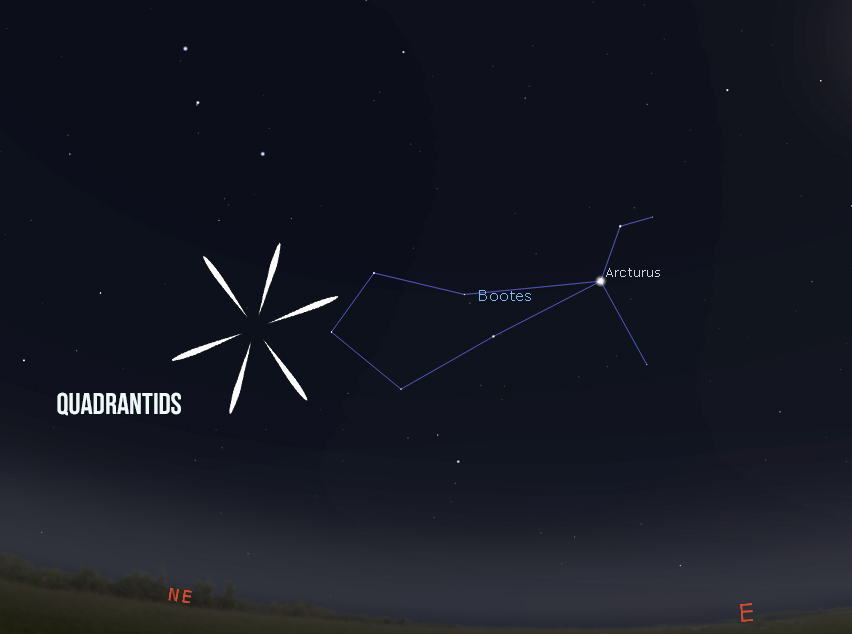
In the early morning of January 4th, Boötes will be positioned in the northeastern quadrant of the celestial sphere, achieving significant elevation around 03:00 (though visible from 01:00 given an unobstructed horizon). For observers lacking familiarity with celestial cartography, one may simply direct their gaze toward the East-Northeast at an altitude (elevation) of to . The prominent star Arcturus ( Boötis) serves as an excellent reference marker in the eastern sky during this period.
Full Moon and Supermoon Phenomena
The Moon will reach its plenary phase (Full Moon) at 17:02 (Vietnam Standard Time). This temporal occurrence coincides closely with the Moon’s passage through perigee—the point in its orbit closest to Earth. Consequently, the lunar disk will exhibit an angular diameter approximately 7% larger and a luminosity 15% greater than an average Full Moon, a phenomenon colloquially termed a “Supermoon.” Indigenous cultures of North America traditionally designate the January Full Moon as the “Wolf Moon,” associating it with the mid-winter period when wolves emerge from their dens to forage and howl.
From an astronomical perspective, the “Supermoon” concept has gained prominence primarily through media discourse rather than scientific classification. The variance in apparent brightness and angular size is often negligible to the unaided eye. Crucially, regarding the concurrent meteor shower maximum, this superposition creates suboptimal observing conditions, as the intense moonlight interference will essentially wash out the majority of meteors in the adjacent celestial regions.
Given these photometric constraints, while the concurrence of these celestial events appears intriguing, observational reality suggests otherwise. It is advisable to conduct observations of the Quadrantids several days prior to the maximum, when the Moon is in an earlier phase and sets earlier, preserving sufficient sky darkness for post-midnight observation.
Earth at Perihelion
This event marks the annual moment when Earth traverses the point of minimum heliocentric distance in its orbit, designated as perihelion. The precise timing for the 2026 epoch falls between the night of January 3rd and the dawn of January 4th. At this juncture, the Earth-Sun distance is approximately 147.1 million km (contrasted with the mean orbital distance of 149.6 million km). However, this is strictly an orbital mechanic event; it produces no observable alteration in the celestial sphere or atmospheric conditions.
Nevertheless, akin to a modest celestial firework display for the New Year, it is hoped that the Quadrantids and the early 2026 sky will provide inspiration for a fresh beginning.
 Khanh's Gallery
Leave a comment