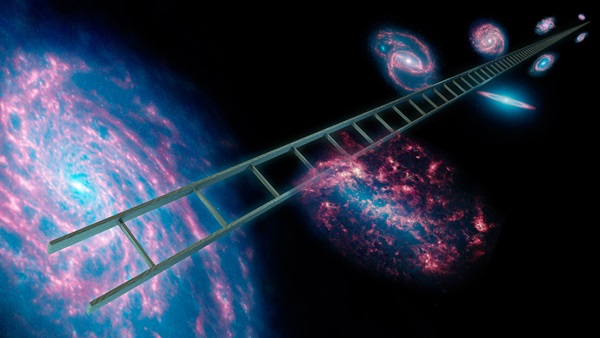
Distance is one of the most important measurements in our daily lives. We use it to decide how long a commute will take, how large a room feels, and how far we can travel in a day. Yet unlike color or brightness—things our eyes perceive instantly—distance is invisible. We never truly see it. We infer it through specific tools.
The situation is even worse for astronomers. In daily life, we can walk toward an object, touch it, or place a ruler between two points. In space, none of that is possible. We cannot stretch a measuring tape to the Moon, let alone to a star or a galaxy. Beyond the reach of spacecraft, the universe offers no physical reference points at all. All we receive is light—tiny packets of information that have traveled across vast, empty space to reach our eyes and telescopes.
And yet, from that faint light alone, astronomers can tell us that the nearest star lies more than four light-years away, that the Andromeda Galaxy is millions of light-years distant, and that some galaxies are so far away that their light began its journey before Earth even existed. How is that possible?
The key is that, similar to our normal distance measurements, there isn’t a single universal “ruler” in astrophysics. Just as we switch from a ruler to a tape measure to GPS depending on the scale, astronomy uses many different kinds of rulers—each one designed for a different range of distances. When these methods are carefully calibrated to overlap, they form a chain: each step is anchored by the one below it, and then extends farther than the last.
That chain is called the cosmic distance ladder. In this post, we’ll climb it rung by rung, from the closest geometric measurements, to stars that act as standard candles, and finally to the large-scale expansion of the universe.
Direct Measurement
Radar ranging
The most straightforward way to measure distance is the way we do it in everyday engineering: send out a signal and time how long it takes to return. On Earth, this is exactly what laser rangefinders do. In space, astronomers can use the same idea—radar or laser pulses—but only for objects close enough that the reflected signal is detectable.
For a long time, this “echo” method in astronomy was mainly radar ranging: transmit radio waves toward a nearby target (like Venus or an asteroid), then measure the round-trip travel time. Because electromagnetic waves travel at the speed of light, the distance is simply:
where is the speed of light, and is the total time traveling. The factor 2 is inferred from the fact that the radio pulse travels to the target and back.
More recently—especially “lately” in the context of modern astronomy—laser-based techniques have become a powerful extension of this idea. The clearest example is Lunar Laser Ranging: we fire laser pulses at retroreflectors left on the Moon, and detect the tiny fraction of photons that return. This doesn’t measure interstellar distances, but it gives extraordinarily precise distances within the Earth–Moon system and helps anchor dynamics and reference frames with incredible accuracy.
Still, there is a hard limit: once you move beyond the Solar System, the return signal becomes impossibly faint. You can’t bounce a laser off a star 10 light-years away and expect it to come back. So to measure distances to stars, we step onto the next method—one that doesn’t require any reflection at all.
Parallax
Parallax is the oldest “cosmic ruler” because it’s basically pure geometry. If you shift your viewpoint, nearby objects appear to move against a distant background. You can see this by holding up a finger and alternating your left and right eye: the finger “jumps” relative to whatever is behind it.
Astronomers use this interesting geometry property as one of the oldest distance calculations. However, instead of using the spacing between our eyes, we use the diameter of Earth’s orbit as a baseline.
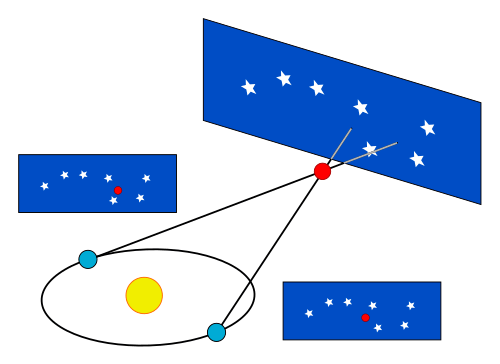
A simple interpretation of using the Earth’s orbital radius as a baseline.
Stellar parallax is most often measured using annual parallax, defined as the difference in the apparent position of a star when observed from two points on Earth’s orbit separated by about six months (i.e., effectively from opposite sides of the Sun). For much smaller distances—for example, the Earth–Moon distance or nearby planets—astronomers can instead use two different locations on Earth (or the same location at different times as Earth rotates) to measure parallax. This is called diurnal parallax. The diurnal parallax was used by John Flamsteed in 1672 to measure the distance to Mars at its opposition, and from that to estimate the astronomical unit and the overall scale of the Solar System.
Although parallax is the most direct and geometrically reliable way to measure distance, it has a fundamental limitation: the parallax angle becomes extremely small as the distance increases. Because parallax scales inversely with distance, a star that is twice as far away shows only half the shift on the sky. For stars hundreds or thousands of light-years away, the apparent motion is so tiny that it approaches the precision limit of even the best instruments.
For this reason, parallax can only map our local region of the Milky Way. To reach beyond it, astronomers must rely on new kinds of “rulers” that do not depend on tiny angular shifts, but instead on the intrinsic brightness and physical properties of stars and stellar explosions. This is why parallax forms only the first rung of the cosmic distance ladder, anchoring all the larger-scale methods that follow.
Standard Candles
Standard candles are astronomical objects that belong to a class with a known intrinsic brightness. If we know how luminous an object truly is, then by comparing that to how bright it appears from Earth, we can infer its distance—because light spreads out as it travels, following the inverse-square law. Objects used this way are called standard candles, a term closely associated with Henrietta Swan Leavitt’s work on variable stars.
Standard candles come with two core challenges. The first is calibration: astronomers must determine the candle’s true intrinsic brightness (absolute magnitude). That requires clearly defining the class so members can be identified, and collecting enough well-measured nearby examples (with independently known distances) to pin down the correct absolute magnitude accurately. The second is reliable identification: when observing very faint, distant objects, it becomes harder to confirm that an object truly belongs to the standard-candle class. Misclassifying an object can introduce large distance errors, especially at the extreme distances where standard candles are most needed.
A broader, recurring concern is whether the candles are truly “standard” across cosmic time and environment. If the intrinsic properties of the objects change with conditions or distance, then extrapolating a locally calibrated brightness to the far universe can systematically bias distance estimates and, in turn, bias the cosmological parameters inferred from those distances.
Some of the standard candles are listed below:
- Variable stars (e.g., RR Lyrae, Cepheids) follow the period-luminosity relationship.
- Type Ia supernovae have a fixed absolute magnitude ().
- Special points on the revolution of stars: Tip of the Red-Giant Branch (TRGB), Planetary Nebula Luminosity Function (PNLF), Globular Cluster Luminosity Function (GCLF).
Galaxies’ properties and relations
At distances where individual stars can no longer be resolved, astronomers rely on the global properties of galaxies. Unlike standard candles, which depend on the intrinsic brightness of specific objects, these methods use empirical relations between observable galaxy characteristics and their physical sizes or luminosities. Once calibrated using nearer distance indicators, these relations allow distances to be measured across large volumes of the Universe.
Surface Brightness Fluctuations (SBF)
The key idea of the Surface Brightness Fluctuation (SBF) method is that while a galaxy’s average surface brightness does not depend on distance, the small-scale brightness variations do. As a galaxy gets farther away, each star appears fainter, but more stars fall into each pixel, keeping the mean surface brightness unchanged. However, the random fluctuations caused by individual stars are averaged out, making the image smoother. Measuring how these fluctuations decrease allows astronomers to determine the galaxy’s distance.
Tully–Fisher relation
The Tully–Fisher relation applies to spiral galaxies. It states that a galaxy’s intrinsic luminosity depends on its rotation velocity , which reflects the total mass of the galaxy and is independent of distance:
Once the intrinsic luminosity is determined, the distance is found using the inverse-square law.
Faber–Jackson Relation
The Faber–Jackson relation applies to elliptical galaxies. It links the intrinsic luminosity of a galaxy to the stellar velocity dispersion , which measures the depth of the galaxy’s gravitational potential and does not depend on distance:
Again, the distance is then obtained by comparing intrinsic luminosity with observed flux.
Relation
For elliptical galaxies, distance estimation relies on the relation, which connects a galaxy’s stellar velocity dispersion to a characteristic physical diameter . . The velocity dispersion is measured from the width of absorption lines and reflects the galaxy’s gravitational potential.
The empirical relation is
By inferring the galaxy’s true physical size from and comparing it with the observed angular size, astronomers can determine its distance.
Redshift and Hubble’s Law
At the greatest distances in the Universe, even entire galaxies become unresolved, and methods based on intrinsic brightness or internal structure reach their limits. At this scale, astronomers rely on the expansion of space itself to measure distance. This approach is based on cosmological redshift and Hubble’s law, forming the final rung of the cosmic distance ladder.
As light travels through an expanding Universe, its wavelength is stretched, shifting spectral lines toward the red end of the spectrum. This effect is quantified by the redshift , defined as the fractional change in wavelength. For relatively nearby galaxies, where the expansion speed is small compared to the speed of light, the redshift can be converted into a recessional velocity using .
Hubble’s law states that this recessional velocity increases linearly with distance:
where is the Hubble constant, which sets the present-day expansion rate of the Universe. Importantly, the value of cannot be determined from redshift alone. It must be calibrated using distances measured from earlier rungs of the ladder, such as Cepheid variables, Type Ia supernovae, and galaxy scaling relations.
Once calibrated, redshift measurements allow astronomers to estimate distances to galaxies billions of light-years away, far beyond the reach of any other method. At this final rung, measuring distance is no longer just a geometric problem—it becomes a probe of cosmic history, linking the scale of the Universe to its expansion and evolution.
Summary
In the end, measuring distance in the Universe is not so different from measuring it in daily life: we never grasp it directly, only through carefully chosen references. From rulers and laser pulses on Earth, to stellar parallax, standard candles, galaxy scaling relations, and finally the expansion of space itself, each rung of the cosmic distance ladder extends our reach by trusting what we can measure to infer what we cannot. Distance, invisible yet fundamental, becomes a bridge between observation and understanding. By learning how far the Universe stretches, we are also learning how deeply human curiosity can reach—step by step, rung by rung, from our own doorstep to the edge of the observable cosmos.
Astrophysics fascinates us precisely because of its uncertainty. We are rarely granted direct answers; instead, we advance by reducing ignorance step by step, guided by faint clues carried across immense distances. Learning astronomy is like groping in the darkness of the Universe, where the only things we can hold onto are fragile threads of light that have traveled for millions or billions of years. From those few photons, we patiently reconstruct distances, motions, and laws, slowly turning darkness into understanding. In this way, astronomy is not just the study of the cosmos, but a quiet testament to how human reasoning can extract order from uncertainty—one careful measurement at a time.
Once again, I really like a saying from Sir Isaac Newton:
Science is standing on the shoulders of giants.
And this is completely true for the process of finding distances in the universe.
 Khanh's Gallery
Leave a comment